
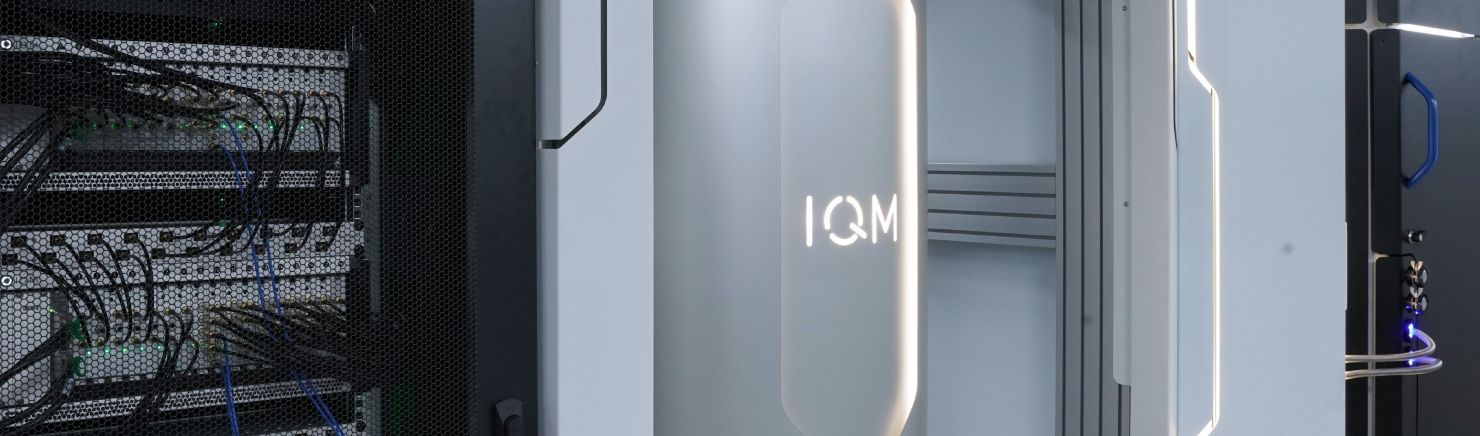
The test phase successfully completed: Researchers and companies from across the European Union are officially granted access to computing time on Euro-Q-Exa. This quantum computer is based on the superconducting Radiance technology from IQM Quantum Computers, offers 54 qubits and is currently being connected to high-performance computing or HPC systems at the LRZ. In the medium term, Euro-Q-Exa will be expanded to up to 150 qubits.
Designed for integration into high-performance computers, the system minimises latency and maximises computing power, particularly in hybrid workflows. The computer offers tunable couplers and high-fidelity gates, that enable a lattice topology. It is optimised for running large-scale algorithms and is cooled to below –273 degrees Celsius by a cryostat to stabilise the sensitive computing units. With this architecture, Euro-Q-Exa is already pushing the boundaries of classical HPC: The results from quantum systems with more than 50 qubits can no longer be fully replicated using classical supercomputers, as this overwhelms the working memory; and Quantum algorithms enhance HPC applications and can improve them as has already become evident during the experimental phase of Euro-Q-Exa.