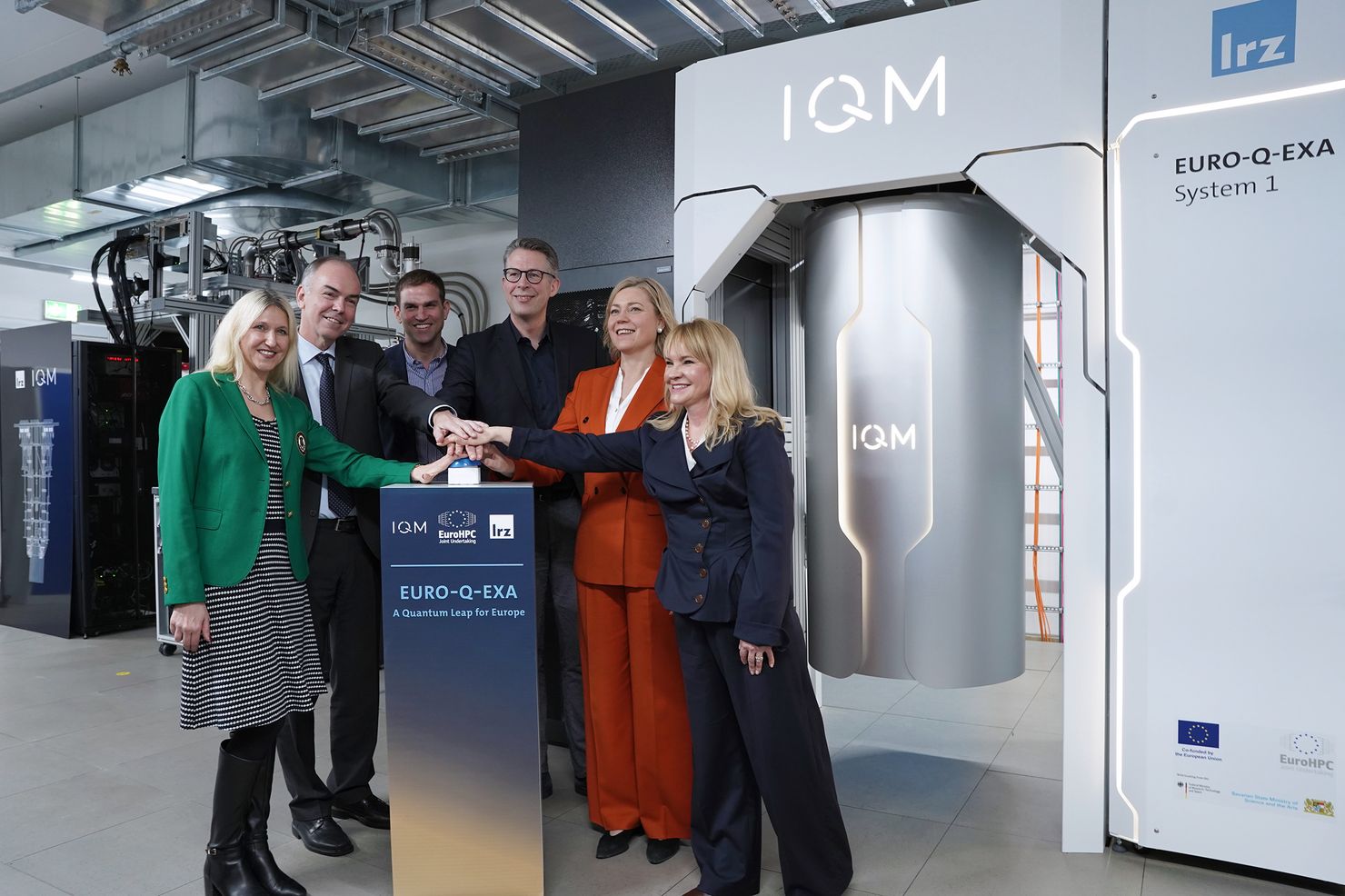
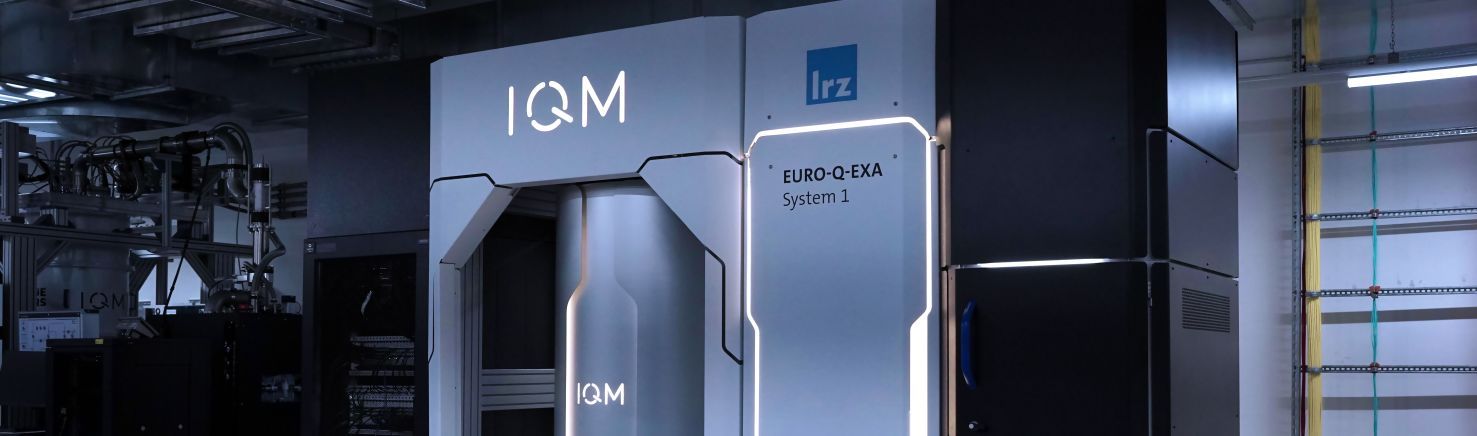
The starting signal for the journey into unknown dimensions has been given. In the presence of Henna Virkkunen (Executive Vice-President of the European Commission for Technical Sovereignty, Security and Democracy), Dr. Silke Launert (Parliamentary State Secretary, Federal Ministry of Research, Technology and Space) and Markus Blume (Bavarian State Minister for Science and the Arts), the European quantum computer 'Euro-Q-Exa' at the Leibniz Supercomputing Centre (LRZ) of the Bavarian Academy of Sciences and Humanities (BAdW) will begin working on research projects for the scientific community in Europe. Based on the 'Radiance' system from IQM Quantum Computers, Euro-Q-Exa features 54 quantum bits (qubits) made of superconducting circuits. A second, more powerful quantum computer with 150 qubits is expected to be added to the system by end of 2026.
Euro-Q-Exa is one of six quantum systems being integrated into European supercomputers by the EuroHPC Joint Undertaking to achieve technical independence in quantum computing. The European Union and the German Federal Ministry of Research, Technology and Space (BMFTR) will cover €10 million and €12 million respectively for the system, its operation and additions, while the Bavarian State Ministry of Science and the Arts (StMWK) will provide €3 million. The BMFTR is also financing the necessary personnel and material resources.
The LRZ will host and operate the innovative quantum computer. The computing centre in Garching has gained extensive experience in integrating various quantum technologies into supercomputers, as well as in operating them. Euro-Q-Exa is the second hybrid quantum computer that the LRZ has installed in collaboration with IQM Quantum Computers and made available to scientists via the Munich Quantum Portal (MQP). Euro-Q-Exa reliably offers higher availability of quantum computing: if one of the systems is undergoing maintenance, researchers can continue working on the other. When coupled with the LRZ's supercomputer, Euro-Q-Exa enables hybrid workflows, combining classic supercomputing with new quantum computing.
Euro-Q-Exa uses IQM's Radiance technology. Designed for integration into high performance computers, the system minimises latency and maximises computing power, particularly in hybrid workflows. The computer offers tunable couplers and high-fidelity gates that enable a lattice topology. It is optimised for running large-scale algorithms and is cooled to below -273°C by a cryostat, stabilising the sensitive computing units and rendering them usable.
With this architecture, Euro-Q-Exa will push the boundaries of high-performance computing (HPC). While quantum processors (QPUs) with up to 50 qubits can still be simulated on a supercomputer, this is hardly possible with 54 qubits, or only possible in several steps, due to the amount of RAM required. This is because, theoretically, each additional qubit doubles computing power.
The principle of how quantum computers work is different; they use superposition and entanglement between multiple qubits, enabling them to solve mathematical problems such as the travelling salesman problem, an optimisation task from logistics that involves finding the most efficient route between locations. The number of possibilities increases exponentially with each additional location: with 10 locations, there are several million possibilities; with 58 locations, the number of variants rises to a tredecillion, which is a number with 78 digits. This makes calculation using classical methods extremely complex.
Such tasks are common in trade and logistics, as well as in finance and microchip design. Additionally, scientists hope that quantum computers will one day enable them to model electron interactions in an atom, molecular behaviour, and other quantum mechanical states more precisely and efficiently. However, coherence times, noise and susceptibility to interference still limit the performance of quantum computers, although larger experiments and results are already feasible in this field of research when they are combined with classical supercomputers.
Euro-Q-Exa will be made available to German and European researchers via the Munich Quantum Portal (MQP) and the EuroHPC JU portal. This means that the quantum computer can be used either on its own or in combination with SuperMUC-NG, and in the future with Blue Lion – the next supercomputer at the LRZ. The system offers a variety of programming languages, as well as widely used quantum software packages such as Qiskit and PennyLane. These are provided by the Munich Quantum Software Stack (MQSS), which is being developed at Munich Quantum Valley (MQV) in collaboration with universities, research institutes and companies, and is now available for Euro-Q-Exa. The MQSS supports hybrid algorithms and workloads, as well as the development of programs for quantum computing, and offers interfaces to useful software packages.
The first research groups from Europe and the MQV have already expressed their interest in using Euro-Q-Exa to break new ground. For example, they want to use it to decipher the causes of neurodegenerative diseases, expand the methods of computer-aided pharmacology, refine climate models and improve power grids. They also hope to finally find out how quantum computers achieve their much-vaunted advantage. According to the latest findings, achieving quantum advantage requires more than just a large number of qubits and efficient entanglement.
To the press release of EuroHPC JU
To the press release of IQM Quantum Computers
Henna Virkkunen, Executive Vice-President of the European Commission for Technical Sovereignty, Security and Democracy: “As the quantum market is still nascent, the European Commission is actively shaping it: Through EuroHPC, and together with Member States, we have already procured and co-funded the first six European quantum systems. Four are operational, and two more are under procurement. This is a clear demonstration of Europe’s commitment to building sovereign quantum capacity on our own continent. The Leibniz Supercomputing Centre stands as a concrete example of this ambition in action. It shows how we can successfully support and scale up leading European providers such as IQM, who are at the forefront of quantum innovation. By anchoring these systems in Europe, we are strengthening our industrial base and ensuring that strategic technologies are developed and deployed in Europe, for Europe. With the new system — and its substantial upgrade planned for early 2027 — we are already enabling complex quantum computations today. This is not a distant promise; it is operational reality.”
Markus Blume, Bavarian Minister of State of Science and the Arts: “Germany’s first European quantum computer is being installed at the Leibniz Supercomputing Centre in Bavaria, which is no coincidence, but the result of our strong high-tech ecosystem. The fact is: Euro-Q-Exa is much more than just a new computer. It represents technological sovereignty and our ambition to develop our own digital infrastructure. At Germany’s largest research campus in Garching, a vibrant hub for European ideas, we are combining quantum computing, supercomputing and artificial intelligence to create new dimensions in computing. This is precisely why we are also applying to host an AI gigafactory. Projects like this demonstrate Bavaria’s readiness to take responsibility for Europe’s digital future. Garching is sending out a strong signal: this is where the computing resources that enable innovation and strengthen our technological capabilities are being created – this is where the future is not only being conceived but also being calculated.”
Anders Jensen, Executive Director of the EuroHPC Joint Undertaking: “The inauguration of Euro-Q-Exa represents another milestone in our journey towards a world-class European quantum computing infrastructure. This new EuroHPC quantum system reinforces our commitment to providing researchers, industry, and the public sector with cutting-edge computational resources, fostering innovation and technological sovereignty across Europe.”
Prof. Dieter Kranzlmüller, Chairman of the Board of Directors, LRZ: “With Euro-Q-Exa, we are combining the strengths of quantum and supercomputing. This gives researchers the opportunity to test new approaches and implement groundbreaking calculations, opening up new scientific dimensions using European technology. Here at LRZ, we are looking forward to embarking on some exciting research projects and gaining new insights.”
Dr Jan Goetz, CEO of IQM Quantum Computers: “The countries that own their open quantum infrastructure, not just access to the cloud will lead. Europe is building toward that: locally operated systems, education of the new generation, hybrid HPC integration, and the institutional expertise that only comes from ownership.”