
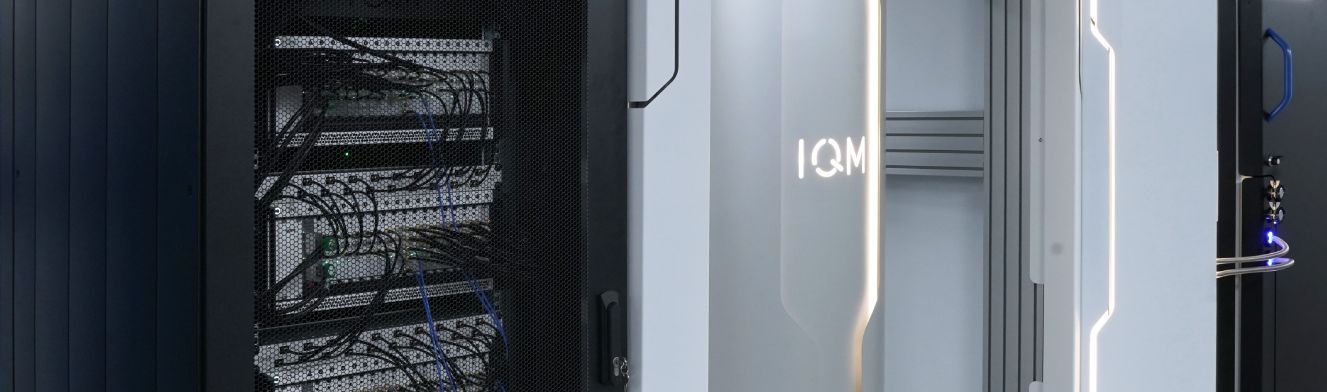
A total of 13 research teams and 25 users, initial publications and studies: at the end of May, the pilot phase concluded, marking the start of operations for Euro-Q-Exa, the quantum computer based on supercomducteds circuits with 54 Qubits, hosted by the Leibniz Supercomputing Centre (LRZ) on behalf of the EuroHPC Joint Undertaking. “We invited already well-known research groups in Europe to intensively try out the new system with us and to test workflows,” says Dr. Luigi Iapichino, who leads the Quantum User Enablement and Applications Team at LRZ. “During this friendly user pilot phase, various application areas were represented — many researchers worked on benchmarks, optimization issues, or error mitigation on Euro-Q-Exa; in addition, we supported experiments in quantum machine learning as well as hybrid simulations that combine classical resources with the quantum computer.”
The research team led by atmospheric physicist Dr Mierk Schwabe from the German Aerospace Centre (DLR) is working to harness the potential of quantum computers for Earth systems and climate models. One of the aims of the DLR’s Quantum Computing Initiative (DLR QCI) – and in particular the Klim-QML project – is to use quantum machine learning (QML) to improve and expand existing models, thereby enabling robust climate forecasts and assesments of potential technologie impacts, particulary in the fields of aerospace, transport and energy. “These developments for climate protection are still in their infancy,” says Schwabe. “Climate models are often too large even for supercomputers; their resolution is therefore often still very coarse, and processes such as clouds, their formation or turbulence cannot be resolved at all.” However, because they are important for weather conditions and climate, they are parameterised – that is, simplified in separate models and simulated using smaller computational scales: “These ‘sub-models’ are not perfect; they lead to errors, which we traditionally compensate for through machine learning,” explains Schwabe. Because these processes are nevertheless important for weather patterns and climate, they are parameterized—that is, simplified in separate models: “These ‘sub-models’ are not perfect and lead to errors that we classically compensate for using machine learning,” explains Schwabe. Her team is now transferring this process to quantum computing, also because the computing power of new technologies raises hopes for more detailed and comprehensive climate and Earth system models while enabling new computational methods for simulations. “We were very happy to get the opportunity to test these methods also on Euro-Q-Exa, a very performant superconducting quantum computer that offers us new possibilities besides the access to the DLR QCI quantum computers”, says Schwabe.
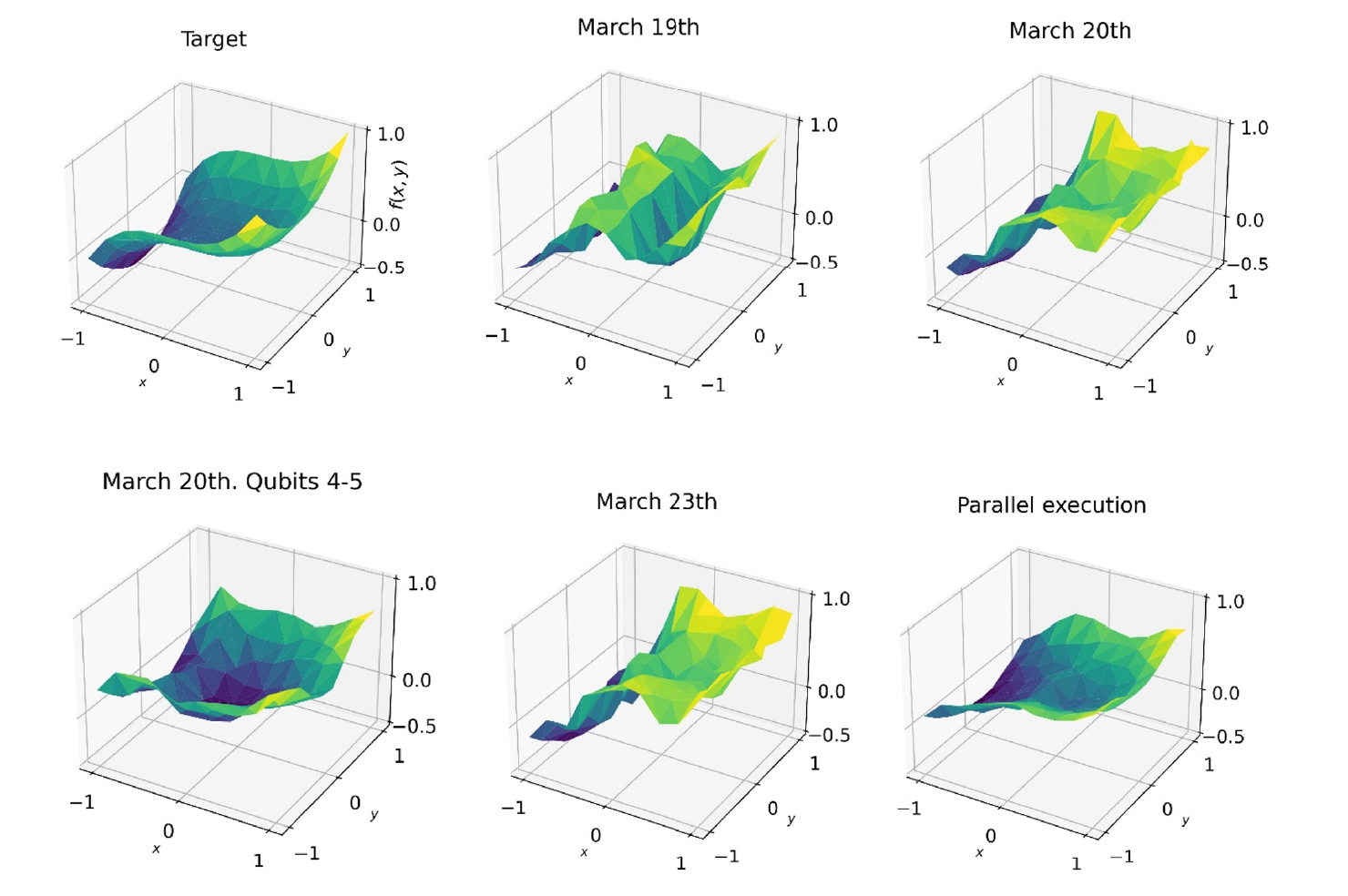
Dr. Hedwig Keller, a mathematician in Schwabe’s group who develops methods to couple QML-models to the climate model, therefore conducted experiments on Euro-Q-Exa with two smaller models. “The transition from simulated to real quantum computing was much easier than expected,” she says. “We ran two quantum models, a simple, two dimensional wave function and a larger model for cloud cover. We had previously trained both in a quantum computing simulation.” In March, Keller ran these programs on Euro-Q-Exa on several days, working with 2 or 6 qubits, testing computational units of varying quality, and attempting to parallelise jobs—that is, to run multiple models with different values simultaneously. “Although the Euro-Q-Exa system was recalibrated every day, the results were already quite similar,” the mathematician observed. “Quantum hardware is still noisy, which affects models and results, but this influence seems consistent to a certain degree.” Consequently, it can probably be minimised through changes in programming or through a hardware-specific optimisation.
Euro-Q-Exa provides 54 qubits; computers of this size are still considered “noisy” (Noisy Intermediate-Scale Quantum, NISQ) and error-prone. Despite regular calibration, the quality of the qubits fluctuates. Therefore, during the test phase of Euro-Q-Exa, several groups also developed strategies for error mitigation and correction — forming the basis for developing their own programs and more reliable hardware. Euro-Q-Exa is based on superconducting circuits. Its processing units, the qubits, are cooled and stabilised by a cryostat and activated by microwave pulses to assume states between 0 and 1, or superposition, and to become entangled with one another via quantum gates. Quantum circuits then arrange these gates in the correct temporal sequence for algorithms and functions.
Through entanglement and superposition, quantum computers gain computing power and speed: they can process calculations with multiple inputs simultaneously, operate exponentially faster, and each additional qubit multiplies performance. With 54 qubits, Euro-Q-Exa is already approaching the limits of the size of a quantum state which, classically, the Random Acess Memory (RAM) of a high-performance computer (HPC) like the LRZ flagship system SuperMUC-NG would not be able to handle.
For the development of quantum software, Euro-Q-Exa offers adapters to the most used software tools like Qiskit and PennyLane as part of the Munich Quantum Software Stack (MQSS), which adds further tools and interfaces for developing applications, including for hybrid high-performance computing that combines or accelerates supercomputing with quantum computing.
Following its initial experiments and experiences with Euro-Q-Exa, the DLR team is already planning to expand on these possibilities: “We cannot yet compute a complete climate model on a quantum computer,” says Schwabe. “Most of these models run on classical systems, but we can recompute and improve some components using quantum computing, and for that, strong coupling of the quantum computer with supercomputers is crucial.”
The integration of Euro-Q-Exa with SuperMUC-NG Phase 2 is still in progress, but a connection already exist to the Bavarian Energy Architecture and Software Testbed (BEAST). Quantum computing at LRZ can additionally be combined with AI resources. A team from University College London (UCL) and other partners from TUM, LMU, QMatter, NVIDIA IQM and LRZ led by computer scientist Prof. Peter Coveney has already tested these possibilities during the pilot phase: The group modeled a G protein-coupled receptor (GPCR)—molecules on the surface of cells that receive signals via hormones, neurotransmitters, or light and transmit them into the cell interior— in a workflow including both Euro-Q-Exa and classical GPU resources. The result is of interest to the pharmaceutical field because the simulation shows how GPCRs respond to drugs.
During the test phase, the User Enablement and Application Team as well as the first users not only gained practical experience working with Euro-Q-Exa. The DLR team recently published a paper outlining how quantum computing can be leveraged to advance climate modeling and is planning another publication incorporating Euro-Q-Exa experiences. Meanwhile, the UCL team has also reported about their hybrid quantum-classical study of proteins. “We could use the quantum computer even better if methods for error correction were incorporated,” says mathematician Keller. “The experience with Euro-Q-Exa is helpful in developing models which can efficiently run on quantum computers and better use its size of 54 qubits.” She hopes for support in error correction—through exchange with other researchers, improvements to the hardware, or specialized programs that still are in development. vs | LRZ