“The network is like electricity from the socket. It simply has to be there,” states Prof. Helmut Reiser, deputy director of the Leibniz Supercomputing Centre (LRZ). “These days, people are more likely to accept a power cut and the lights going out than an internet connection that’s no longer working.” Reiser and his team are responsible, amongst other things, for the Münchner Wissenschaftsnetz (MWN) which reliably connects Munich’s research community both internally and internationally. It forms the basic communications infrastructure and is essential for all other services provided by the LRZ. Last year, the network team gradually upgraded the MWN’s core network in such a way that none of the students, academics, researchers or administrative staff noticed a thing. On average over a five-minute period, more than 70,000 devices are using the network simultaneously – totalling several hundred thousand.
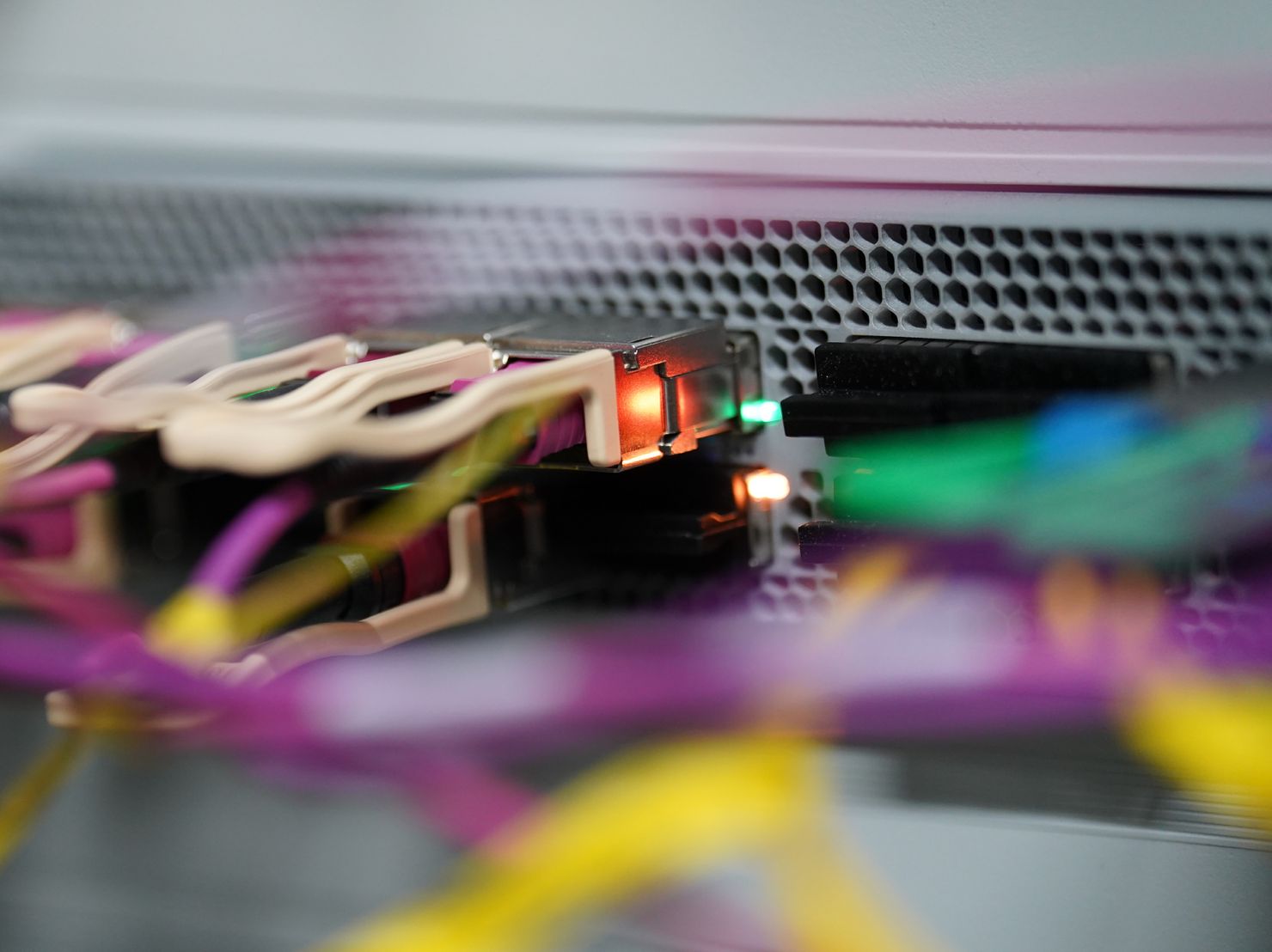
Via a good dozen routers, the MWN backbone connects the LRZ with the university and higher education sites in Munich, Garching, Weihenstephan and Martinsried. From these hubs, countless further connections extend to the campus areas, research facilities, buildings, academic departments, and also to halls of residence. The highest point on the MWN is the Schneefernerhaus on the Zugspitze; the westernmost point is in Heilbronn, where the Technical University of Munich (TUM) operates another campus; and the northernmost point leads to Weihenstephan-Triesdorf University of Applied Sciences. “The routers were getting on in years and had reached the end of their technical life,” says Reiser, explaining the backbone upgrade. “They couldn’t handle higher data transfer bandwidths and also consumed a lot of electricity.” They also took up a lot of space: the old Cisco Nexus 7000 routers were roughly the size of a desk cabinet or measured 21 height units (HU), whilst the new ones from Arista are machines measuring just under one square metre and a good four centimetres high (1 HU).
To ensure a smooth transition to the new core network, the LRZ-team for the communication networks (KOM) first used new technology to build a second parallel backbone, as well as interfaces to the existing one. The various areas to which the MWN provides connectivity were then switched over in stages: “We set it up so that the new network was operational from a software perspective, and then we switched over in stages,” explains Reiser. “This does cause interruptions to network operations, but they are so brief that they are barely noticeable in day-to-day use.”
The upgrade took around two years from planning to implementation. At the same time, the configuration of the new routers was automated, meaning that none of the network specialists need to log into individual routers on the core network to change and test settings. This process is now handled in a central database: “This allows any errors to be rectified more quickly, making the MWN’s operation more stable, consistent and straightforward,” says Reiser. “The new backbone now offers sufficient capacity to increase bandwidths in the campus and other areas as required. More data can be transmitted and the network becomes more future-proof.” Until now, the MWN’s core network could transmit around 100 gigabits of data per second; this volume can now be multiplied, for example when researchers transfer images and other files, codes and algorithms from their workstations to the storage or to the supercomputers at the LRZ. LRZ | vs