

Since the start of operating mode of Euro-Q-Exa, Europe’s 54-qubit system, quantum computing at the Leibniz Supercomputing Centre (LRZ) has entered a period of significant change. Over recent months, the former Quantum Computing and Technologies (QCT) department, which successfully integrated several quantum computers with high-performance computing (HPC) systems, transferred a number of responsibilities to partners. As a result, some colleagues moved to other organisations. Since August, computer scientist Tobias Guggemos has been transforming the team into a versatile research group that will explore quantum technologies and their applications from a holistic perspective.
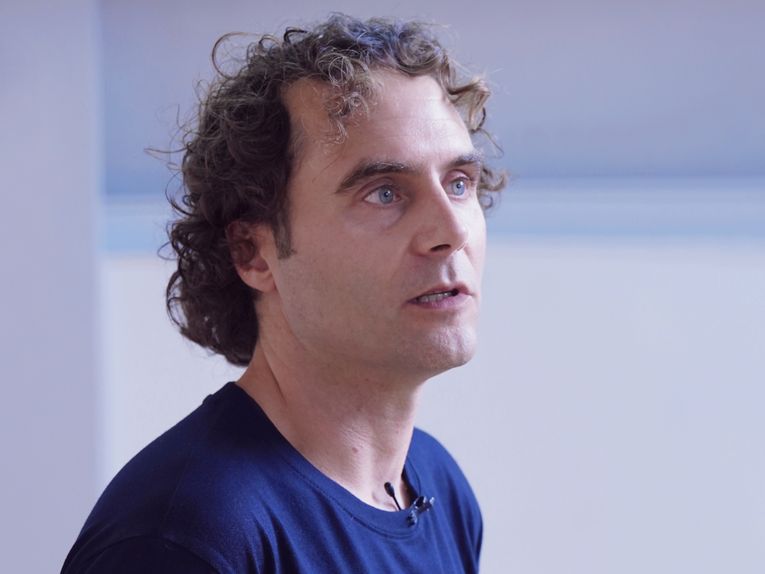
The new head of LRZ’s Quantum Technologies team is approachable and down-to-earth, with a talent for explaining complex and highly abstract topics in an engaging and often humorous way. In this interview, he discusses new challenges and his plans for the future of quantum technologies at LRZ.
How does someone become a quantum computing specialist?
Dr Tobias Guggemos: During my PhD at LMU Munich, I was tasked with preparing a lecture course on quantum computing. To explain the subject to students, I had to immerse myself deeply in the topic, and that sparked my enthusiasm for exploring it further. You inevitably encounter questions of cryptography and security, which were already central to my doctoral research and later became relevant in projects and in supervising Bachelor's and Master's theses. As a postdoctoral researcher, I was able to apply my expertise at the Faculty of Physics at the University of Vienna and at the German Aerospace Center’s Institute of Earth Observation, where colleagues and I developed technology to bring a quantum processor into space.
Why am I at LRZ? Now we have reached the point where quantum computing is genuinely becoming part of everyday practice. Computing power is advancing rapidly, and the systems here are beginning to be used for the first demanding applications. There are still many open questions, which is exactly why I am at LRZ. We work with a variety of quantum technologies, help users push them to their limits, and gain valuable experience that improves our understanding of both hardware and software.
What do you find particularly fascinating about quantum computing?
Guggemos: For me, the most fascinating concept is still entanglement. At its core, it is a rather simple mathematical concept, yet it has enormous implications for technology and quantum systems. Entanglement, superposition, and quantum states are notoriously difficult to explain. I still have not found a way of describing them clearly without resorting to sketches on paper. Yet entanglement underpins every form of quantum advantage, whether in computing, communication, sensing, or sensor technology.
Why would you send a quantum computer into space?
Guggemos: Because you can? (laughs) The project was driven largely by curiosity, nobody had done it before. If you speak about quantum advantages, we should consider all the ways and places in which it might be used. There were also practical considerations. The satellite industry increasingly aims to perform computations as close as possible to the data source, an approach known as edge computing. Communication with satellites is expensive and difficult to maintain continuously due to the distances involved. Publicly funded organisations such as the DLR operate ground stations, but communication is only possible when a satellite is within range. If larger volumes of data need to be transferred, communication time quickly becomes a bottleneck because of the short overflights and additional capacity must be purchased. The alternative is to equip satellites with computing capabilities. Organisations such as DLR, which collect image datasets of several gigabytes, therefore have a strong incentive to preprocess or analyse data directly on board to save time and costs. In future, quantum computers may play a role here, as they promise advantages in data processing.
Does the technology still work?
Guggemos: The prototype on the satellite consisted of a camera whose images were analysed by a quantum processor directly on site. If you take that concept further, the computer could simply transmit the results of the analysis, such as the GPS coordinates of a wildfire. And yes, the satellite is still operating. The camera is still functioning as well. Unfortunately, the processor is not.
What attracts you to projects like this?
Guggemos: Doing something that has never been done before is the cherry on top for any researcher. If a project succeeds, it leads to publications and recognition. What excites me is implementing something while never being entirely certain whether it will work. We broadly understand how to build reliable satellite hardware, but figuring out how to send a photonic quantum processor into space and connect it via fibre optics and optical components in a way that survives the shocks and vibrations of a rocket launch is incredibly motivating. To solve a wide range of mechanical, thermal and technical challenges, we had to immerse itself in areas that were entirely new to us. At the same time, we were assembling the satellite in a clean room, organising logistics, testing hardware, developing software, and figuring out how to maximise the number of experiments we could conduct within very tight operational windows.
What lessons did you bring back to LRZ from that experience?
Guggemos: That things never quite go according to plan (laughs). Planning is important, but the project taught me resilience when dealing with unexpected problems.
As head of the Quantum Technologies team, will you now spend more time solving problems than conducting research?
Guggemos: I hope not. Research is an essential part of my role and responsibility. After all, research is about solving problems and creating knowledge. Over the coming months, the team and I will identify areas for applied research that are particularly relevant for LRZ.
The quantum team has been renamed and reorganised. What does that mean in practice?
Guggemos: It was a strategic decision to transform LRZ’s department Quantum Computing and -Technologies into the research group Quantum Technologies. As a result, some responsibilities associated with integrating quantum processors into HPC environments are no longer handled directly by LRZ. This includes areas such as the in-house development of access portals, programming interfaces, and system-integrated software. There will no longer be a dedicated operations team, so all group members will combine research with responsibilities related to operating the systems. The team itself will become smaller but more diverse in terms of research topics. Some software development work has been transferred to a start-up that is responsible for the further development and commercialisation of the Munich Quantum Software Stack.
Does this mean LRZ’s involvement in the Munich Quantum Software Stack (MQSS) has come to an end?
Guggemos: No. We are currently in a transition phase and still work very closely together. In the medium term, the company will take full responsibility for software development, while LRZ will act as a user and integrator. MQSS will remain installed on all of our systems, and we will continue to offer it to users for application development. The relationship will gradually evolve into a collaborative partnership focused on scientific questions surrounding the use of the software stack. Responsibility for development, maintenance, and commercialisation will rest entirely with the company.
Supercomputing 2026 or SC26 takes place in Chicago in mid-November. How will you present yourself in your new role, and which contacts will be important?
Guggemos: As head of the Quantum Technologies team at LRZ, my main objective is to establish connections with research institutes industry representatives. I want to understand which technologies they are developing, what they can offer us, and where opportunities for collaboration exist. Colleagues will also be active at the conference, including through a tutorial on integrated quantum computing and HPC. In this new role, I am able not only to showcase what the organisation can do but also to help shape expectations and requirements. That is very exciting and creative. Over recent months, companies have already begun interacting with me differently. There is relatively little they can sell directly to LRZ, given that we are publicly funded, but we can offer meaningful partnerships where we jointly advance technologies, development projects, and applications. (LRZ | vs)
Translation generated using AI
Image Credit: © LRZ | V. Hohenegger
In Part 2 of our interview on the future of quantum technologies at LRZ, discover why quantum computing is evolving into a sophisticated tool for science and what challenges and research questions this transformation presents for the LRZ team Quantum Technologies.