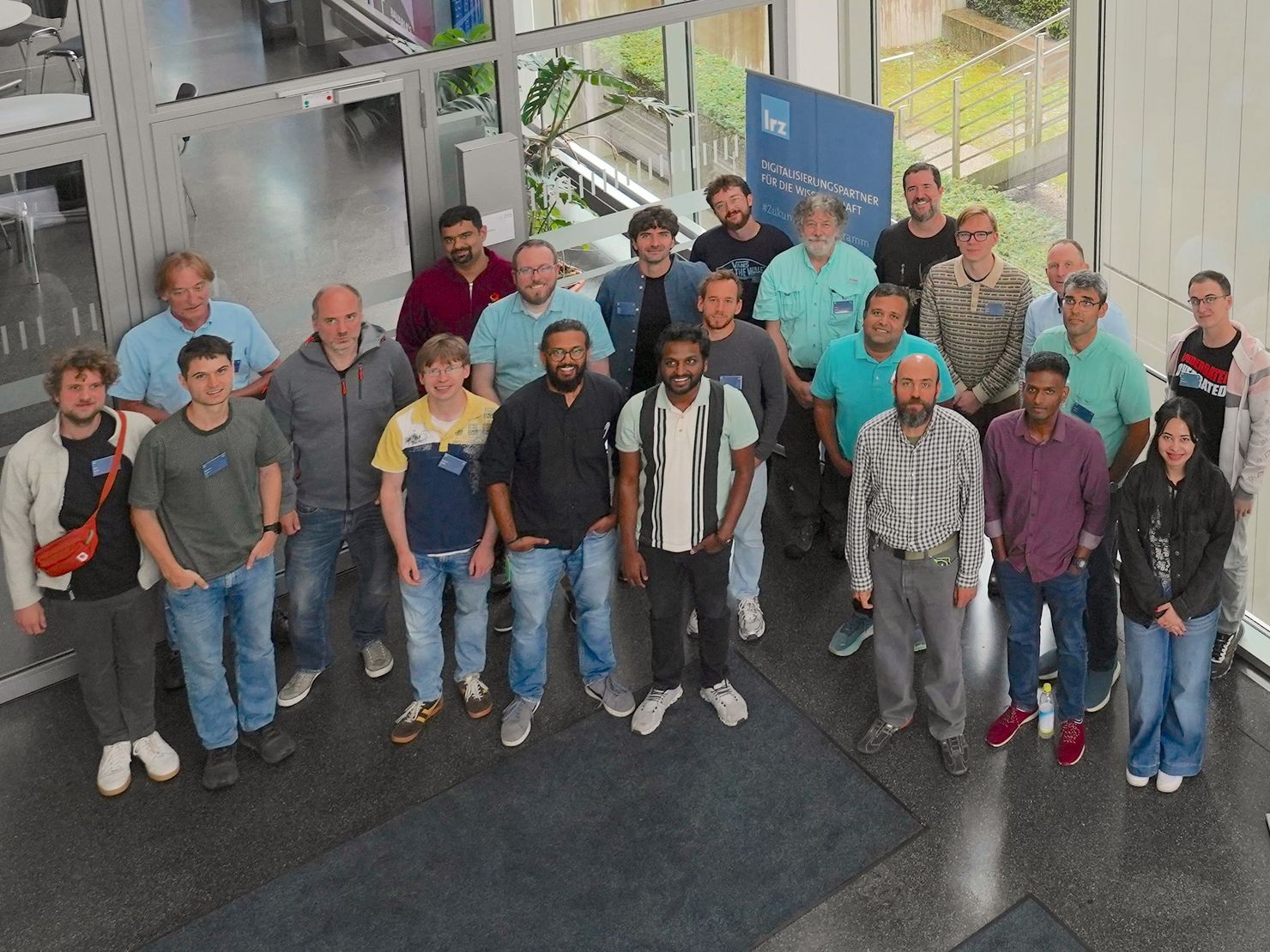

In the seminar rooms of the Leibniz Supercomputing Centre (LRZ), small groups stand in front of flipcharts discussing diagrams. Or they sit together, coding on laptops, only occasionally breaking the concentrated silence: in early September, 30 researchers from European and US supercomputing centres worked intensively on artificial intelligence (AI) systems or models for science and research. The Trillion Parameter Consortium (TPC) Europe had invited participants to the LRZ for the autumn hackathon. “At the TPC hackathons, plans and discussions turn into action,” says Prof. Charles Catlett, Senior Computer Scientist of Argonne National Lab (ANL) and a member of the TPC strategy team. “During the event, participants can get to know potential collaboration partners and their working methods, plan projects together, work on ideas in a practical way, or share experiences and ensure that these spread more quickly throughout the community.”
In the light of the rapid global spread of generative AI tools and the risks they pose, the TPC was launched during the SC23 supercomputing conference by ANL, the Japanese RIKEN Centre and European Barcelona Supercomputing Centre (BSC). “TPC aims to become a sustainable movement for the use of AI in science and to promote research into it, as well as trustworthy programmes,” explains Catlett. In addition to regular hackathons, TPC organises conferences and workshops worldwide and publishes tutorials on AI-supported research.
From the outset, European high-performance computing centres such as the LRZ have actively supported this community. Consequently, TPC Europe was established in Barcelona in 2024, its own office and organisational structures followed in spring 2026 with the funding of the EuroTPC Project by EuroHPC Joint Undertaking: During the TPC annual conference 2026 in Boston in early June, members from Europe met at the LRZ. Some of their presentations were streamed to the US and to other satellite events, and vice versa. Two of the four TPC hackathons of the year took place in Europe, in spring at CINECA in Italy, in fall at LRZ in Garching. “Within the EuroTPC Project, the LRZ has taken on the task of drawing up a EuroTPC roadmap,” reports Dr. Nicolay Hammer, head of the LRZ’s Big Data & AI (BDAI) team. “To this end, we are currently gathering recommendations and topics from researchers and institutes to devise EU strategies and foster the use of AI in science.”
Agentic AI will feature very prominently as a topic in this context. Special tasks were already suggested for the TPC hackathon in the context of agentic use of AI workflows. In those cases large language models coordinate jobs in data processing together with other AI tools and interact with them to carry out actions.
For example, one of the teams at LRZ worked on agentic workflows to develop hypothesis generation for protein. Another working group from the Gauss Supercomputing Centre (GCS) developed initial workflows to enable an AI agent to adapt code to various supercomputers, thereby simplifying access to a wide range of HPC systems. “For me, the most important thing during the TPC hackathons is the exchange of ideas; it also allows me to learn about different approaches or how technology is used,” says Mitja Sainio, a Machine Learning (ML) engineer at the Finnish CSC – IT for Science Centre, who collaborated with the GCS team. In addition, the hands-on work helps building networks of contacts that AI specialists can turn to for practical advice in their day-to-day work.
Energy efficiency is another issue for which solutions were sought during the TPC hackathon. “The more agentic AI is used, the more energy is consumed due to inference workloads,” notes LRZ researcher Ajay Navilarekal. “We need to limit that.” In light of initial incidents and risky system attacks by AI agents, the risks and boundary violations associated with agent-based systems were also on the agenda: to protect data and prevent these digital assistants from running wild, another team from GCS worked on developing security strategies on how authentication and authorization workflows would look like for AI agents.
Alongside more technical issues, a focus was on AI-supported research: for example, a team from the Munich Centre for Machine Learning (MCML) investigated how researchers can use language models to formulate benchmarking algorithms and develop them more quickly. Meanwhile, another group focused on risk prevention and pandemic preparedness with the help of AI. “The seven working groups pursued different objectives at the TPC Hackathon,” observed Navilarekal. “Some wanted to develop an initial, simple prototype that they could continue working on separately, whilst others arrived with code that they wanted to optimise and expand upon. In any case, working together has led to progress.” It also provided inspiration – Catlett from ANL prompted the discussions to consider how AI agents could safeguard and enrich urban life by analysing environmental data from cameras and sensors. Dr. Miguel Vazquez from the BSC and Dr. Arvind Ramanathan from ANL, who develop AI systems for bioinformatics and genomics research, gained new impetus, potential collaboration partners and ideas for projects. “The TPC community brings together a unique pool of expertise,” notes Vazquez. “This will enable us to successfully establish AI and agentic AI across all areas of research.” LRZ | vs
Image Credit Symbolic Images: adobe.stock.com – Hub, Corona Borealis, Сергей Шиманович, Zerofukuman