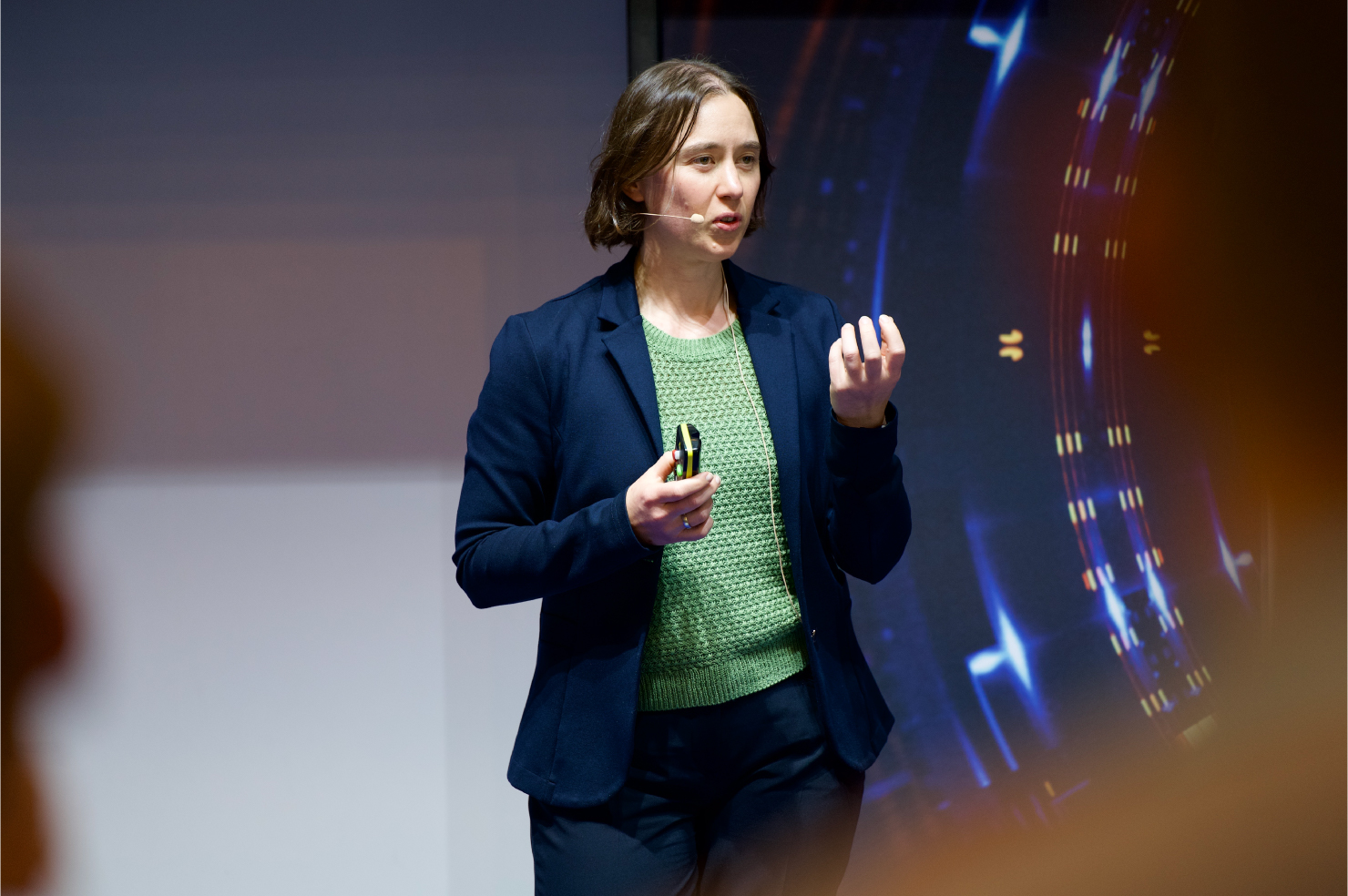

Based on ion traps, photons, neutral atoms, diamonds, or superconducting circuits: various quantum computers are currently being built in Europe, and most chips and systems already exist in several generations. But how can these technologies be compared, progress measured, or system performance assessed? Jeanette Lorenz, a physicist with a PhD and habilitation from the Fraunhofer Institute for Cognitive Systems (IKS), and her team sought answers. They confronted four different technologies with an optimization problem from mathematics: the traveling salesperson problem. They used
— Q-Exa from the Leibniz Supercomputing Centre (LRZ), a system based on superconducting circuits with 20 qubits,
— the AQT system at LRZ, which uses ion traps and lasers to provide 20 qubits,
— a system from Pasqal, using neutral atoms with 10 to 100 qubits, and
— a quantum annealing system from D-Wave with around 5,000 qubits.
In the paper “Application-Driven Benchmarking of the Traveling Salesperson Problem: a Quantum Hardware Deep-Dive”, the researchers describe the differences and insights gained from the comparison. “Each platform we tested was at a different level of maturity and had properties that influenced the design of algorithms,” says Lorenz, who argues: “We should confront technologies and systems with a broader spectrum of computational tasks and algorithms — from mathematically demanding ones to practical ones like the traveling salesperson problem — to better compare their progress.” She adds that the field lacks common benchmarks and standardized metrics concerning technology, operation, and performance, which are essential to classify, improve, and further develop this young, innovative class of computers as well as to understand and contextualize manufacturers’ plans.
The Fraunhofer researcher has already applied for computing time on the first European quantum computer in Germany: “Specifically, we are interested in aspects of integration, the interaction between classical and quantum computing, and how we can develop software for hybrid workloads,” Lorenz explains. “With Euro-Q-Exa, we will also be better able to explore which research tasks are appropriate for quantum computers. It doesn’t yet provide a quantum advantage, but it is an essential step toward better systems for science and engineering.” In the interview, Lorenz corrects some misconceptions and describes what is already possible in quantum computing today.
You confronted various quantum technologies with the travelling salesman problem – do these system already deliver concrete answers?
PD Dr. Jeanette Lorenz: No, these quantum computers — like most current systems — cannot solve the travelling salesman problem. The available hardware still shows limitations, and existing algorithms cannot always be adapted or optimised for specialised systems. Consequently, in quantum computing we can only deal with simple problems or experiments. That does not mean these computers are useless. On the contrary: researchers use them to study how technologies and hardware work, which algorithms they respond to, and how we can integrate them with classical resources for control. We also need metrics to compare the performance and functionality of different technologies and qubits, as well as to better assess technological progress in quantum computing.
Your goal was to compare quantum technologies. What are the key findings?
Lorenz: Quantum computers require two states that can be superimposed. Today, this is realised using different technologies. Superconducting circuits create artificial qubits, while systems with ion traps or neutral atoms work with real particles and perfect qubits. One finding was that each platform we tested had a different maturity level and properties that influenced algorithm design. In our study, we qualified differences by confronting all systems with the same computational problem: the travelling salesman problem. For example, one observation is that qubits based on superconducting circuits operate faster but with more noise or higher error rates; another is that neutral-atom systems can encode computational problems into qubit connectivity. Again, we should test technologies and systems with a broader spectrum of computational tasks and algorithms.
You call for unified benchmarks for Quantum computers and algorithms – which numbers matter?
Lorenz: Speed is certainly a decisive factor, but so is the reliability of the results, as well as values related to the properties of the technologies that also affect operational aspects. Does a quantum system require cooling? How easily can it be integrated into classical computers? What latency arises when both systems interact? We found that cloud access — the main way quantum computers are currently offered through data centres or providers — is rather unfavourable, as it accumulates latency. If data preparation, post-processing, and quantum computation could be handled in closed blocks, latency would not be a problem. But that’s not how hybrid computing works — thousands or millions of computational steps are exchanged between systems. We should therefore be able to reduce latency through technical means or programming.
Could the travelling salesman problem, which quickly reaches scales that classical computers struggle with, become a benchmark standard for quantum computers?
Lorenz: Today, the travelling salesman problem is approached with a Variational Quantum Eigensolver (VQE), a hybrid algorithm combining quantum and classical methods. One can debate whether it is a good tool for benchmarks. To evaluate quantum computers’ performance, error-tolerant algorithms should be used instead. These are closer to practical applications and rely on logical qubits — combinations of multiple physical qubits used to detect and correct errors. An example is Shor’s algorithm, another hybrid quantum algorithm capable of factoring large numbers into primes. Its quantum subroutine requires perfection — meaning as many perfect qubits as possible — so Shor’s algorithm cannot yet be executed in practice or only on very small scales. But one could modify it so that newer hardware shows whether increasingly larger numbers can be factored.
You have worked with quantum offering up to 20 qubits. Now Euro-Q-Exa offers up to 54 Qubits. What possibilities do quantum computers of this size offer?
Lorenz: I may disappoint some expectations, but this quantum computer is still more of a research toy — though an important one. The qubit count is interesting: 54 qubits are not yet perfect, so its computing power still won’t beat a supercomputer, but Euro-Q-Exa’s results can no longer be fully simulated using standard methods. This is a strange yet extremely interesting situation: so how can we verify that its results are correct? We will evaluate that. Practically speaking, Euro-Q-Exa likely cannot yet solve large-scale computations, but it can certainly run several VQEs, smaller error-tolerant algorithms, compute linear equations, and simulate small to medium-sized molecules.
What are your plans for Euro-Q-Exa – another comparison between systems?
Lorenz: Indeed, we have already applied for computing time. Euro-Q-Exa first shows the progress compared to Q-Exa, the 20‑qubit predecessor at LRZ. It enables new standards and benchmarks, especially for currently available European quantum computers. We are specifically interested in integration, the interaction between classical and quantum computing, and how to develop software for hybrid workloads. With Euro-Q-Exa, we will also better explore which research tasks are suitable for quantum computers. If the 54 qubits were perfect, we could already try larger computations. The system does not yet achieve quantum advantage — this will likely require thousands or even millions of qubits — but it is a crucial step toward better systems for science and engineering. Manufacturers plan to achieve quantum advantage within a few years, but this is still speculative. Many technical solutions must still be developed — and Euro-Q-Exa will help us get there. Interview: vs | LRZ