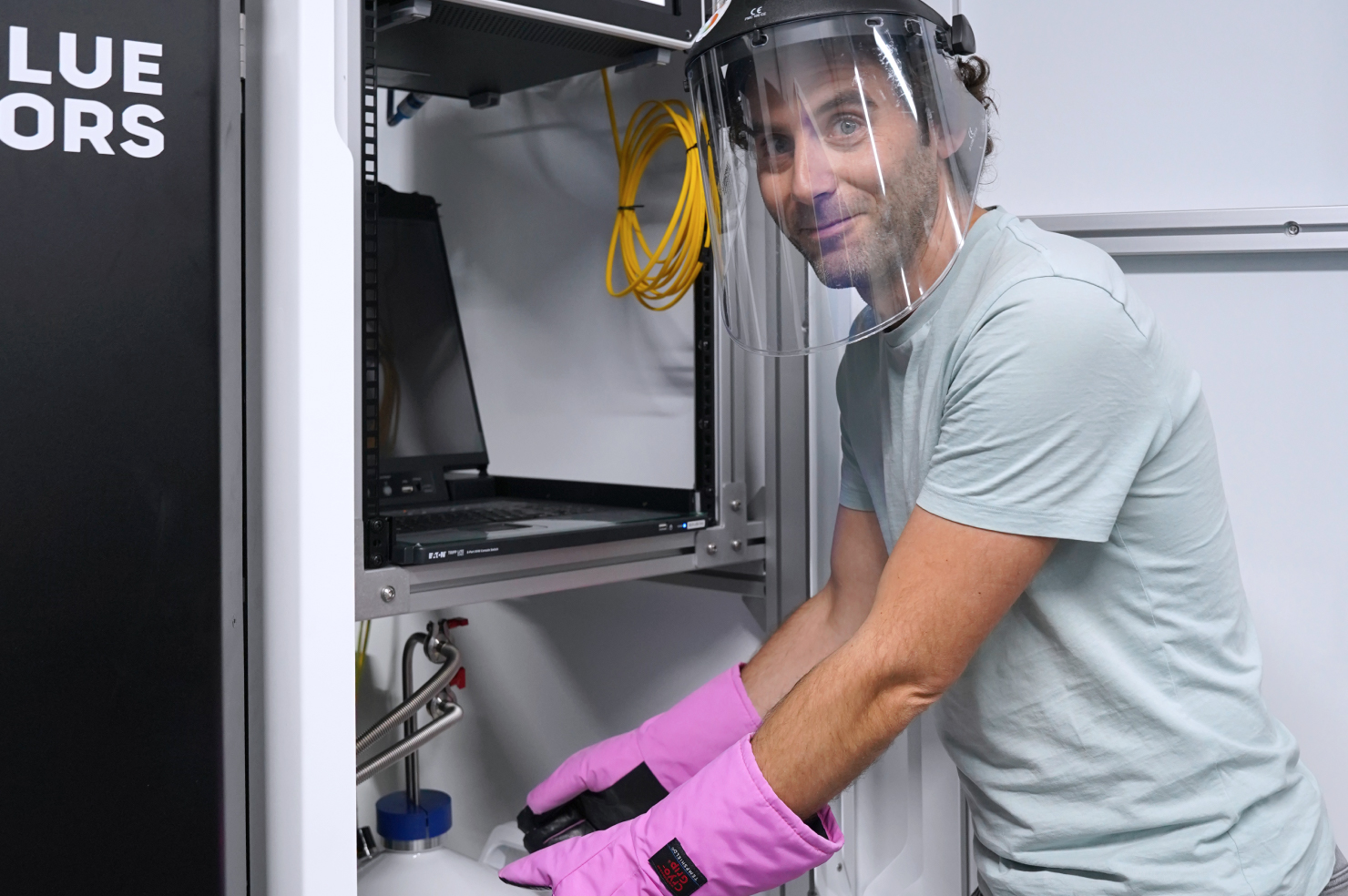
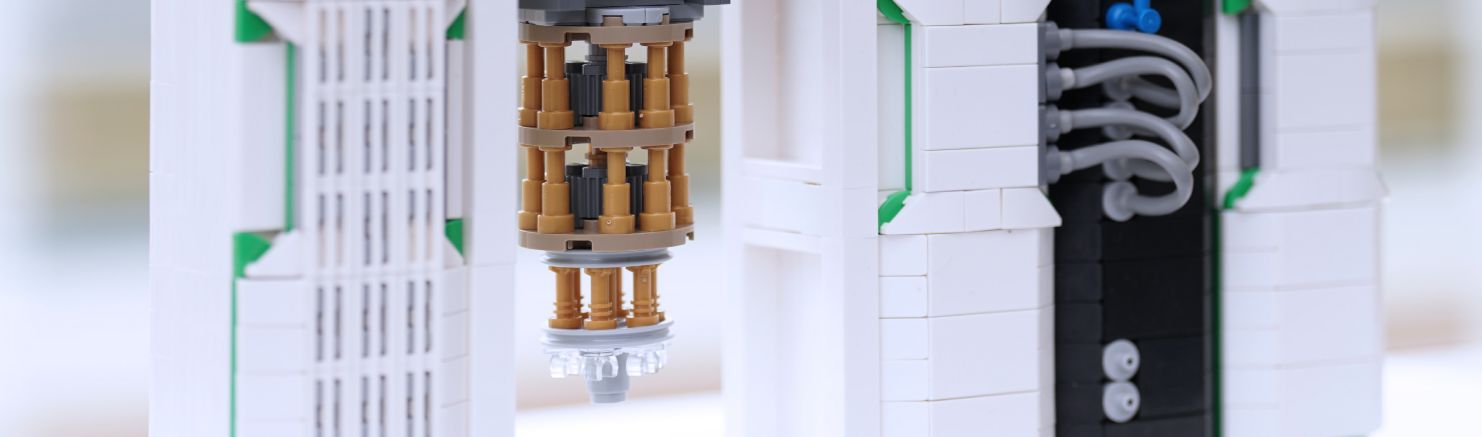
Quantum computers are moving beyond the era of noisy, imprecise calculations. With significantly larger numbers of qubits, they are also delivering steadily increasing computational performance. Quantum computing is evolving from an experimental field into a practical scientific tool. Researchers are gaining ever more opportunities to develop entirely new algorithms for computation and data processing. In the second part of our interview on the future of quantum computing at the Leibniz Supercomputing Centre (LRZ), computer scientist Dr Tobias Guggemos discusses current developments in hardware and software and outlines the new challenges facing the Quantum Technologies team, which he has led since August of this year.
Where do you think quantum computing stands today?
Guggemos: We are currently at the transition from so-called NISQ or Noisy Intermediate-Scale Quantum computing to error-corrected quantum computers. This brings new challenges. On the one hand, both computation and error correction require ever more qubits and increasingly sophisticated algorithms, which in turn raises numerous questions about hardware and infrastructure. How many quantum computers will we need? Can a large, error-corrected quantum computer be cooled using a single cryostat? Can quantum computers be interconnected, and if so, how and how many? These are questions that naturally lead us to consider quantum communication.
On the applications side, quantum systems still cannot be programmed exactly as we would like. Knowledge of the underlying technology and hardware remains essential. Many people believe that we no longer need to think about the specific characteristics of different quantum systems and how we can take advantage of them. However, the most interesting publications usually emerge where researchers provide new insights into hardware and its behaviour. At the same time, many high-level applications are being developed that promise a great deal but do not always deliver in practice.
When do you expect truly standalone quantum computers, systems that operate independently?
Guggemos: A better question might be: do we actually need them, and what would we use them for? Over the last 15 years, the focus has been on algorithms that offer benefits when combined with classical computing techniques. This is largely because there have not yet been quantum computers capable of solving truly large mathematical problems on their own. Even today, there are only a few problems, such as prime factorisation, which forms the basis of algorithms used to break encryption, that could potentially be solved independently by a quantum computer. The hope is that as our experience grows and quantum technology continues to improve, entirely new standalone applications will emerge, applications that we are not even considering today. Identifying these opportunities is one of the goals of fundamental research, including here at LRZ. At present, there are only a limited number of algorithms and applications that offer advantages for data analysis, mainly because the data first have to be transformed into a quantum state. That is far from trivial and often negates the advantages provided by the quantum algorithm itself.
Where does quantum computing stand at LRZ?
Guggemos: We operate several different quantum computers, which allows us to compare hardware directly. Through the projects of our users, we can also observe which systems are best suited for which tasks and explore how different technologies might be used together. It is quite possible that, in the medium term, one part of a project will run on a superconducting quantum computer while another part is processed on a neutral-atom or trapped-ion system, either sequentially or in combination with classical computing. Exploring such strategies represents a tremendous opportunity for research, and LRZ is ideally positioned for this because we provide access to a broad range of quantum technologies.
What interests you more personally: exploring the technology itself or questions about its use?
Guggemos: Primarily the technology, but there is no contradiction there. As a service provider, LRZ has a responsibility to support its users, and the best way to do that is by optimising their algorithms and applications so they can extract the maximum performance from any given technology.
Which technologies are available at LRZ alongside superconducting systems?
Guggemos: A 20-qubit trapped-ion system from AQT is already operational, and the start-up planqc is developing a neutral-atom processor with around 1,000 qubits for LRZ. This reflects Germany’s national funding strategy. Germany is focusing on these three technologies and has launched six major projects to bring them to market readiness while also developing error-correction strategies. LRZ sees itself as a pioneer in this field. Who knows, perhaps we will soon support another technology gain a foothold in scientific research as well.
What is occupying the team’s attention at the moment?
Guggemos: The two Euro-Q-Exa systems that we operate on behalf of the EuroHPC Joint Undertaking currently require considerable operational effort. For the 54-qubit computer, we are organising projects and evaluating user experiences. One more system is now being installed. We are currently determining which network technologies should be available within the system and adapting it to LRZ’s infrastructure. This will be followed by calibration work, after which we will verify whether the system meets the requirements specified in the procurement process. This new Euro-Q-Exa system is expected to provide around 150 qubits capable of achieving entanglement and gate operations at a defined quality level. Assessing this requires substantial expertise and experience. Finally, we are also focusing on identifying new research questions and aligning the team accordingly.
Will users of the first Euro-Q-Exa system have to adapt their algorithms and applications when moving to the larger Euro-Q-Exa computer?
Guggemos: Probably not, although the 150-qubit system will make quantum computing substantially more interesting, particularly from an applications perspective. Many algorithms perform significantly better with larger numbers of qubits when they are applied to real-world problems rather than toy examples. Euro-Q-Exa 2 will allow us to delve deeper into data-intensive fields such as Earth observation, chemistry and materials science, while making fuller use of the entire system for more demanding calculations. This is primarily a question of encoding. Take image data, for example. A pixel can be represented by a qubit, but additional qubits, so-called ancillas, are needed to control colour values and perform calculations. With more qubits, larger sections of data can be analysed or examined in greater detail. However, there is a catch. Results generated on a quantum computer of this scale can no longer be verified using conventional methods. A supercomputer can still simulate systems of 20, 30 or 40 qubits. At around 50 qubits we begin to encounter technical limitations, although comparisons with smaller systems remain possible. At 150 qubits, however, entirely different solutions become conceivable, and verification will require new methodologies or experimental measurements.
Can Euro-Q-Exa also be used independently, without classical HPC support?
Guggemos: Yes and no. Of course, the quantum computer can be used on its own, but it still requires control through classical systems, as well as access via the LRZ's Munich Quantum Portal or the EuroHPC Joint Undertaking portal, under whose mandate we operate both systems. The organisation places particular emphasis on projects including a classical HPC component when allocating computing time. And yes, the quantum computer can perform calculations without a supercomputer. This may become increasingly relevant for the new, larger system. Especially exciting are algorithms and applications that do not merely offer speed advantages but enable entirely new functions and forms of computation. There are already some incredibly exciting cryptographic algorithms for blind computing, which allow quantum computers to perform calculations on encrypted data whilst keeping the data itself encrypted. This is a new approach to data security, but one that requires a large number of qubits.
Were similar questions about result verification already encountered in the early days of classical supercomputing and HPC?
Guggemos: There are certainly parallels with the development of classical computing and artificial intelligence. AI generates results and analyses that can no longer be fully evaluated within a reasonable timeframe. Just as happened with the rise of supercomputing, we are once again reaching the limits of what can be reviewed manually. Machines and networks produce solutions at a pace that makes comprehensive verification increasingly impossible. In the past, rocket trajectories were calculated by dozens of mathematicians working together in a room. Once high-performance computers began producing these calculations within minutes, methods had to be developed to verify the correctness and logical consistency of the results. Today, AI appears to be solving one millennium problem in mathematics after another. That is impressive, but there must still be people capable of understanding the eighty-page papers describing these extremely complex solutions. Not every result generated by AI or a quantum computer can be verified through straightforward calculations or sets of mathematical formulae. Consider molecular simulation as an example. Such simulations typically do not produce deterministic answers but rather probabilistic estimates that approximate a possible outcome. These can be simulated computationally, but the resulting hypotheses still have to be tested experimentally to determine whether a molecule actually behaves as predicted by the quantum model.
Which communities are currently forming around quantum computing?
Guggemos: Through the European calls issued by the EuroHPC Joint Undertaking and the Euro-Q-Exa systems, a network of computing centres is developing that faces challenges similar to those encountered by LRZ regarding integration, operations, scheduling, administration and organisational processes. In recent years, software-development communities have also emerged to define standards and present new tools. We are closely connected with these communities, especially within Munich Quantum Valley, where new questions are continuously debated and collaborative projects launched. We provide users with access to various quantum systems, much like commercial cloud providers, while also integrating them with HPC systems. In particular, users can tailor the HPC environment according to their specific requirements. Companies such as IQM and Amazon do not offer this level of flexibility, as their services are closely tied to their own technologies and software ecosystems. At LRZ, users can work with us to define aspects of how systems are used, helping them combine and exploit technologies more effectively. This is unique and represents the greatest advantage of on-premises quantum computing at LRZ. Users who understand the hardware in detail can be given considerably more freedom.
What questions are users most interested in at the moment?
Guggemos: Like policymakers and funding organisations, researchers are currently most interested in quantum error correction. Hardware is being optimised, and a vast number of new algorithms and software solutions are being developed in this area. This will shape the field over the coming years and will also be a major focus for us at LRZ. We intend to actively support the deployment of increasingly powerful and better-corrected quantum computers. We will contribute our practical expertise, but we do not intend to develop our own hardware or software. Industry is better positioned to do that. Distributed quantum computing and the combined use of different quantum technologies also represent highly promising areas that we will explore intensively together with researchers.
Of all these topics, which interests you most, including for the Quantum Technologies team?
Guggemos: I originally approached quantum computing from the perspective of network security and cryptography, subjects that I pursued extensively during my time at the University of Vienna. I would very much like to deepen that work here at LRZ. The focus is on connecting quantum computers and enabling them to communicate with one another, as well as on exploring how quantum communication can be applied in practice. Using quantum states to exchange keys or codes that secure elections, online payments or other critical information is becoming an increasingly important topic within the European Union. With its network infrastructure and computing services, LRZ is ideally suited for researching such questions. Quantum security and quantum communication will become key focus areas at LRZ, alongside the integration of different quantum technologies. LRZ offers the unique opportunity to operate several high-quality quantum systems side by side. (LRZ | vs)
Translation generated using AI