Scenes from mythology, architectural illusions, political statements: from the 16th century onward, artists painted their visions of heavenly and social themes onto ceilings. In the 18th century, these artworks became fashionable—hardly any representative building or civic house was without such decoration. With the support of the LRZ, the Corpus of Baroque Ceiling Painting has documented thousands of these works. In addition to numerous reconstructions and surveys of historical spaces, the project has also developed virtual reality (VR) applications—essentially creating a virtual museum of these fascinating paintings, along with new methods and tools for the scholarly study of art. “Alongside the central art-historical questions of origin, style, motifs, and their meanings,” says Professor Stephan Hoppe, art historian and overall director of the Corpus, “digitisation now also allows us to study art as a history of sensory perception much more effectively.”
Why was ceiling painting so popular in the Baroque period, and what appeal does it hold for art history today?
Dr. Matteo Burioni: Ceiling paintings initially offer a unique sensory experience; they extend built space into an imagined world, and that is what attracted people. In the 17th and 18th centuries, more and more ceiling paintings were created—not only in churches, monasteries, or princely palaces, but also in civic buildings and town halls. Patrons—including female clients for this genre—and artists used this new medium to engage with themes from politics or salvation history.
Prof. Stephan Hoppe: A real competition emerged, especially in Central Europe, where many of these paintings have survived. The phenomenon itself is widespread across Europe, but for practical reasons the Corpus focuses on works preserved in Germany. One of the first monumental ceiling paintings there can only be seen as a copy today, in the Black Hall of the Munich Residence. On the ceiling, a domed architectural skylight is simulated purely through painting. Ceiling painting, like this example, remains an experience and a source of artistic enjoyment for many people today, as one can actively experience one’s own process of seeing. The Corpus has been collecting and documenting such works since 1966, and for the past ten years we have been using cutting-edge technologies for their digital recording and study.
Why is the digitisation of the Corpus important?
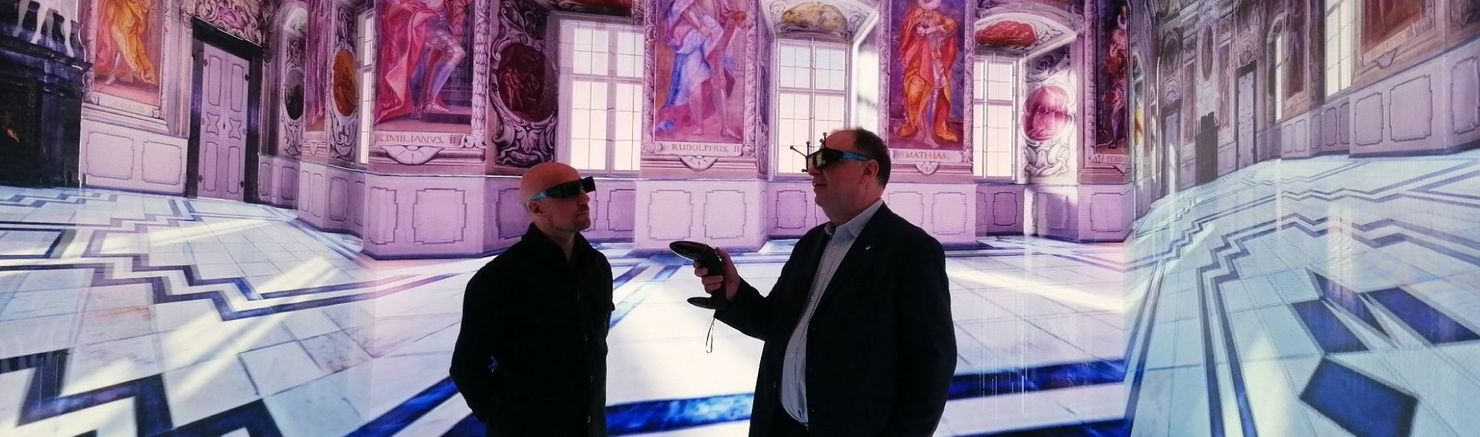
Hoppe: In addition to historical questions about origin, style, technique, or motifs, digitisation now allows us to study art history more effectively as a history of sensory impressions and perception—and digital technology raises many new methodological questions for the field. Digital images can be copied, processed, and presented in entirely different ways. One example: with additional funding from the Bavarian Academy of Sciences and Humanities (BAdW), we were able eight years ago to use high-performance computing systems to generate a three-dimensional model of the Imperial Hall in Bamberg, a ceremonial hall painted illusionistically around 1707–1709 in the former prince-bishop’s residence. This then relatively new data format—a spatial, coloured point cloud—marked the starting point for an intensive and fruitful collaboration with the LRZ that continues today. Through such work, we have learned what can be achieved with algorithms and software, along with the appropriate IT and digital expertise, for this kind of art-historical research. The societal aspect of digitisation is also highly valuable: ceiling paintings can hardly be displayed as originals in a museum, but now they can be made accessible to the public, accompanied by extensive explanations and curated presentations online. We have also been able to digitally reconstruct lost spaces, such as the Renaissance pleasure pavilion of the Munich Residence, demolished in 1804—a 16th-century courtly garden building with illusionistic ceiling painting—and thereby draw attention to this often underestimated period. The Corpus has effectively become a virtual museum of a specific art form, which we continue to expand.
What technologies are used in the digitisation of ceiling paintings?
Burioni: We primarily rely on digital photography and video, as well as photogrammetry and laser scanning to measure the paintings. Naturally, all of these technologies are combined to visualise models or to build spaces in virtual reality. In addition to graphic software, game engines are also used.
What role do virtual reality (VR) and 3D visualisations play for the Corpus?
Hoppe: When we started, 3D visualisations in art history were often still considered mere computer gimmicks—we were even criticised for using them. However, over the course of the project, scholarly communities formed that, for example, methodologically supported these sophisticated reconstructions. This not only led to new research topics and tools, but even to the innovative publication series Computing in Art and Architecture. It was truly fascinating to observe how our field expanded and connected with other disciplines. Above all, three-dimensionality opens up new perspectives. Almost all works of art are inherently three-dimensional—even paintings do not have perfectly flat surfaces and are perceived by people within space. Now, in the LRZ Cave, we can immerse ourselves in art and explore how a composition works within a space. How is a painting perceived from different positions? How did artists arrange lighting conditions in their works? A fourth dimension is added when digital reconstructions are combined with social and economic structural data over time. This makes it possible, among other things, to build corresponding knowledge graphs.
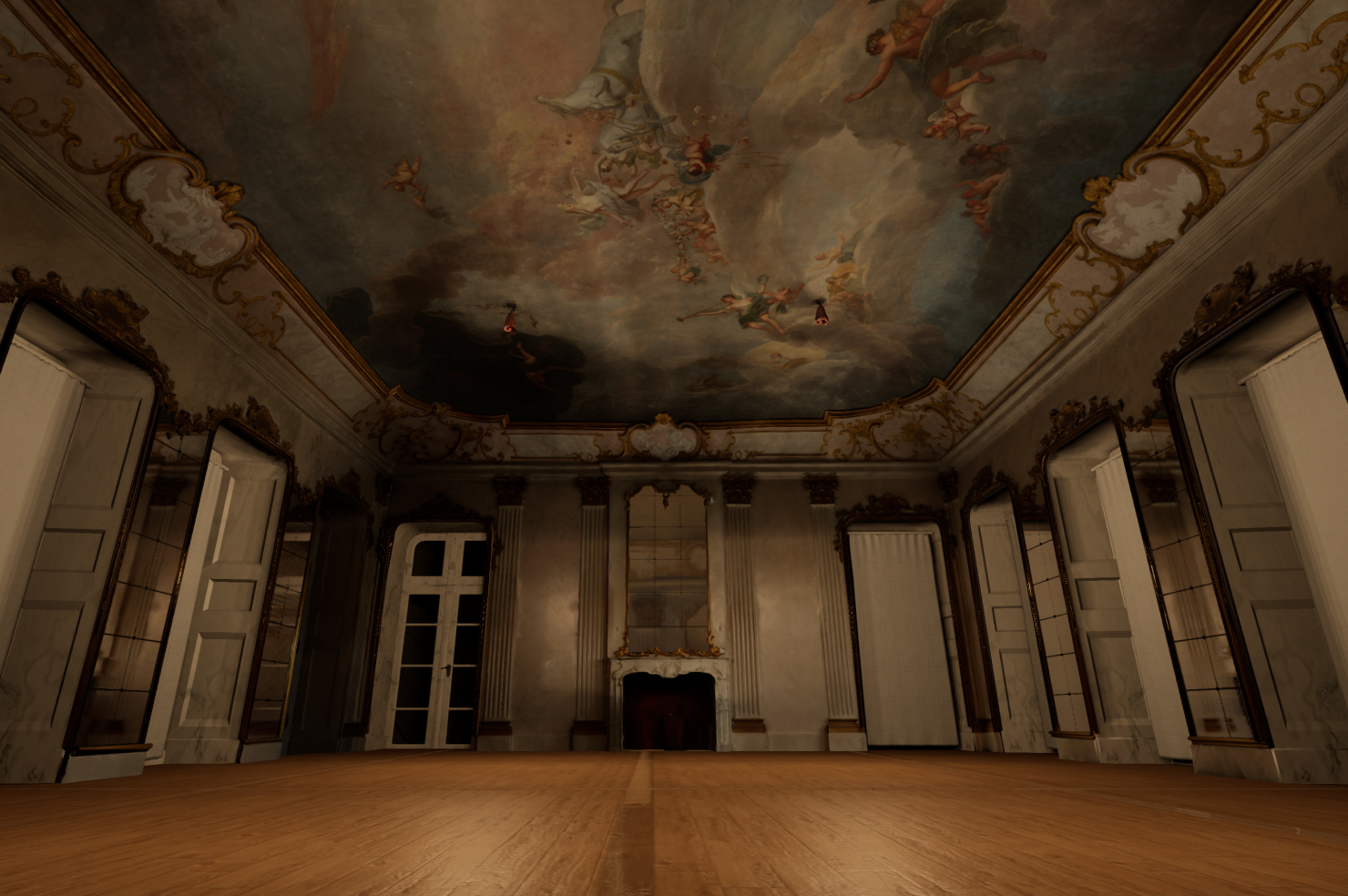
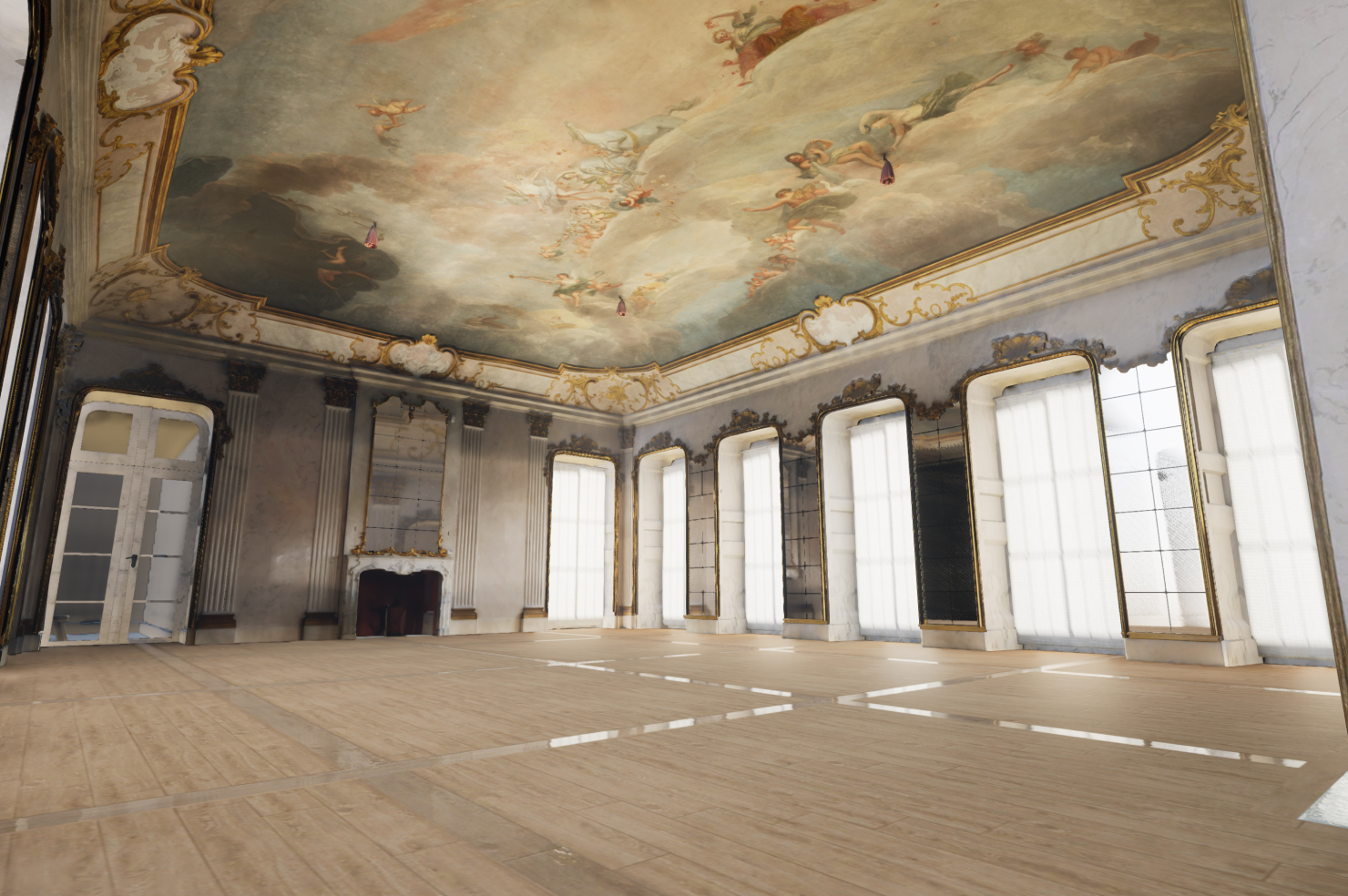
Burioni: Perhaps a practical example: based on a digital survey of Rheinsberg Palace—the Brandenburg country residence where Frederick the Great held court as crown prince until 1740—we developed a simulation of the Mirror Hall illuminated by evening candlelight. This not only demonstrates the effect of light on ceiling painting, but also deepened my research into courtly life and the reception of natural sciences at Frederick the Great’s court. At that time, the findings of physicist Isaac Newton on light were intensely discussed in salons. This is reflected in the ceiling painting, where the artist cleverly incorporated this new knowledge.
The paintings are mapped with additional data on www.Deckenmalerei.eu. What is the benefit of this?
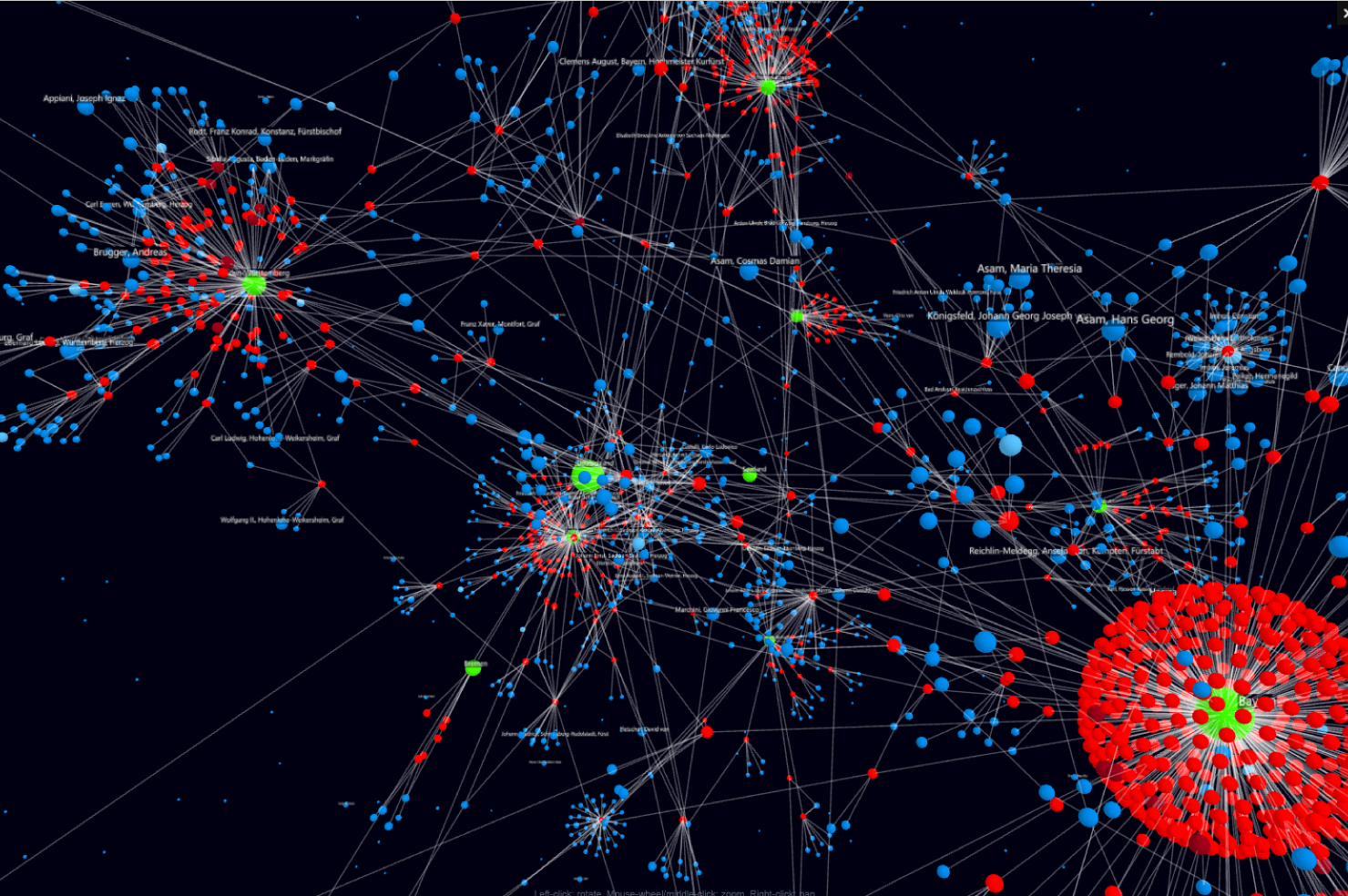
Hoppe: In the age of big data and artificial intelligence, digital images and information are becoming increasingly important as research data—even in art history. We therefore learned early on from the natural sciences and introduced digital research data management for the Corpus. At the time, this was quite new in the humanities. From this emerged a semantic database that structures all buildings, leading from the building to individual rooms and to the paintings themselves. Image cycles, patrons, artists, as well as architects, builders, and craftsmen were documented. In some cases, iconography was converted into standardised art-historical data, such as the globally recognised numerical system of Iconclass, and newly indexed.
Burioni: This allows the data to be analysed even without knowledge of the text. With the help of the knowledge graph, one can, for example, assign artists to buildings and locations, establish connections to patrons, and thus discover communities or networks. Which artists connect different patrons? Who followed which models?
Hoppe: This makes it possible to construct, for example, a social history of artists in ceiling painting, or to compare themes and their treatment across space and time. This is just one approach among many: these connections can also be weighted and analysed using statistical methods to identify patterns that would otherwise be difficult for us to detect. Even 3D models are data structures that can be varied and expanded with additional data. Digitisation thus enables us to capture new aspects of artistic production. Why does a work of art look the way it does? Is it due to a brilliant idea, or do the materials—such as pigments—also influence the outcome? These are questions we have long considered, but which were previously difficult to analyse systematically.
Is the use of AI increasing in digitisation?
Hoppe: The possibility of integrating different sensor data into a multidimensional data model will certainly occupy us in the future. That is why we are very grateful to have access to AI resources at LRZ alongside visualisation technologies. In addition to lighting conditions, we could also integrate eye- and body-tracking into VR applications to evaluate in new ways how such artworks are perceived. Of course, one must distinguish between our present-day perspective and historical contexts. Until recently, however, such studies were generally hardly feasible. Ten years ago, we digitised images, but could only process them in the quantity required for photogrammetry on supercomputers. I was therefore somewhat envious of computational linguistics, which was able to analyse the textual works of authors as early as 30 years ago using computers. These statistical and deep-learning methods are now gaining a foothold in the visual domain and in art history, and they will transform the discipline in many ways. What distinguishes the digitisation of the Corpus is that, in collaboration with LRZ and the BAdW, we can experiment with very advanced technologies. We can professionally analyse big data while also reflecting deeply on what this advanced use of digital tools means for our discipline.
Are there comparable digitisation projects in art history?
Hoppe: Among others, historical stained glass windows are being digitally reconstructed and documented. This brings art history closer to another field—narrative research in literary studies. Stained glass windows depict scenes and stories that, like ceiling painting, can be digitally processed and systematised in context.
How has technological development shaped your work in recent years?
Hoppe: Above all, increased computing power now allows us to process high-resolution image data faster and more efficiently, and software has made enormous advances. Soon after the first visualisation of the Bamberg Imperial Hall, programmers developed new, much more efficient photogrammetry algorithms. Globally readable standardised data has also expanded the project. Ten years ago, formats such as JPG and PNG existed for photos, but there were few formats to represent semantic and structural relationships. Today, we are represented on Wikidata with our own entity. What a development! We recently filled a doctoral position in art history with a computer scientist who has long been interested in our research questions, in order to better assess and utilise developments in AI.
Burioni: There has clearly been a time lag over the past ten years in the development of display and recording technologies. The original data from the Bamberg Imperial Hall are still very good, but with LED technology in the new LRZ Cave they are displayed more brilliantly, precisely, and sharply. Surveying and recording technologies have also improved enormously, allowing us to capture the geometry of spaces and paintings much more accurately. With the help of digital heritage technologies, we recorded paintings at close range during ongoing restorations and were able to create digital twins of spaces—especially poorly preserved Baroque interiors for which only limited data exist. LRZ has shown us various ways to make our reconstructions accessible online and suggested that we work with sensor technologies in the future.
What is next for the Corpus of Baroque Ceiling Painting?
Hoppe: The next step at the core level is the digitisation and study of paintings in monasteries. Incidentally, we are noticing that specialised photographers are becoming scarcer—the professional landscape is changing. We do not know what our photographic methods will look like in 15 years, but perhaps we will be able to create 3D models more easily using other means. New surveying and recording technologies—and, of course, AI both as a technology and as a theoretical field—mean that we still have much to do. As a tool, AI is already able to analyse large image and structural datasets that we previously could barely manage. As a theoretical field, it raises new questions about how machine vision and human perception relate to one another, and what role mathematical methods can play in art-historical knowledge production. Another question is how the work of scholars in the humanities will change as a result. We want to apply AI tools as a team, and we hope for further inspiration through the Academy and its members in terms of interdisciplinarity. We also benefit from the technological innovations we can test at LRZ. This gives us access to a wide range of media informatics and big data processing capabilities—an exceptional and very privileged situation. We will use these opportunities to explore the cultural heritage of ceiling painting and to make our findings even more visible. (vs | LRZ)
Elisabeth Mayer has been involved in the work on the digital corpus of Baroque ceiling paintings for many years and is researching the creation of digital twins in art and architecture. She has visualises various rooms in virtual reality, including a digital twin of the Hall of Mirrors at Rheinsberg Palace in evening or candlelight. These models not only illustrate lighting conditions but also allow new parameters to be integrated in the digital model.
“In the corpus, the rooms and their dimensions play an important role,” says Mayer. “For example, it is difficult to gauge how high the ceiling is on a monitor, but thanks to stereoscopic representations of the rooms using VR, we can better recognise spatial relationships and perceive distances.” Programmes such as Blender were used to reconstruct the halls, and Unreal Engine was then used to create VR applications for the LRZ CAVE.
The resulting digital twins of the rooms can model criteria such as humidity and more, in addition to lighting conditions. The results can be exhibited or researched by scientists without the need to use the room itself. This helps to preserve sensitive works of art.
The work on the Corpus has also provided the LRZ Centre for Virtual Reality and Visualisation (V2C) with a wealth of experience in surveying and recording technologies: “Photogrammetry and laser scanning are excellent for digitally reconstructing rooms, but this requires further work. Algorithms cannot distinguish between a mirror and a window,” explains Mayer. “If, on the other hand, rooms are digitally recreated using a 3D programme, we have greater control over the design and can reconstruct stucco or statues more accurately. The downside of this method is that it is very labour-intensive and time-consuming.” (vs | LRZ)