
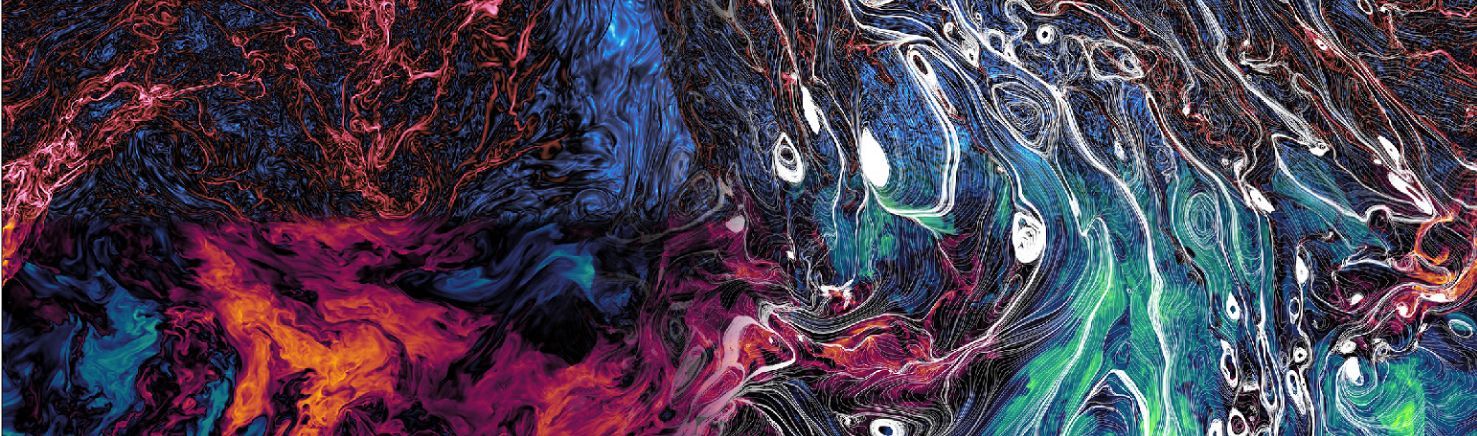
A Glimpse into the universe: At the supercomputers of the Leibniz Supercomputing Centre (LRZ), an international research team simulated and visualised the largest interstellar turbulence to date. This work was honored in St. Louis during SC25, the world’s largest trade show and conference on supercomputing. The trade publication HPCwire awarded the turbulence simulation as the “Top HPC-Enabled Scientific Achievement.” On behalf of the international research team, Prof. Dieter Kranzlmueller, Chairman of the Board of Directors of LRZ, accepted the award from Tom Tabor, CEO at HPCwire.
The turbulence first delivers fascinating images from unknown worlds. These illustrate the chaotic processes and movements of gases and matter in space, where stars can form. Moreover, the model and visualisation challenge previous assumptions about the role of magnetic turbulence and highlight additional topics, for example, for future space experiments.
This masterpiece was created not only with the help of supercomputers and visualisation technology but above all through long-standing, well-coordinated teamwork. We warmly congratulate the core team around Dr. James Beattie, Prof. Christoph Federrath, and Prof. Ralf S. Klessen for this sensational success, which brought us closer to the universe and the swirling clouds of gas and matter within it. To achieve this, the team overcame not only scientific boundaries: In addition to the research group and the LRZ, universities and institutions from all over the world contributed to this excellent work: Princeton University, The Australian National University, Australian Research Council (ARC), Center for Astrophysics | Harvard & Smithsonian, Heidelberg University, Harvard University, Bavarian Academy of Sciences. (vs | LRZ)