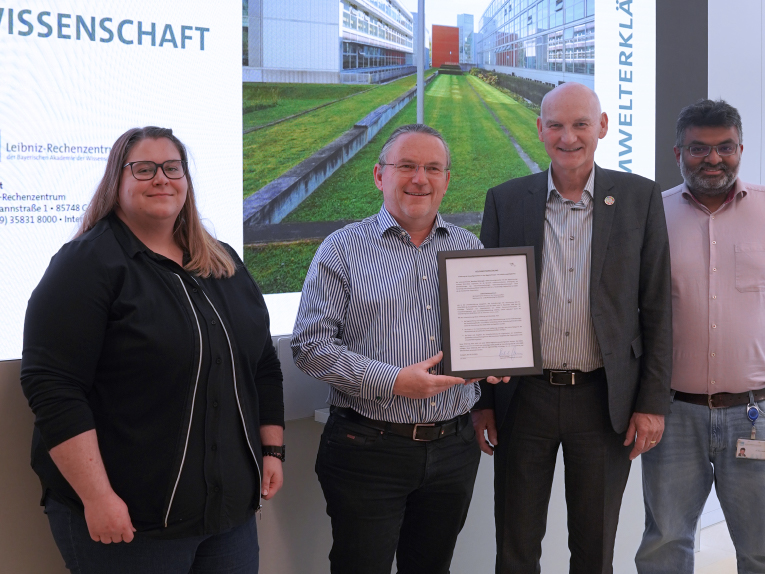
The use of electricity from renewable sources, photovoltaic panels on the roof, electric vehicles in the fleet, and a well-thought-out energy management system for operating high-performance computers, AI clusters, storage and networks: The ecological footprint left by the Leibniz Supercomputing Centre (LRZ) is set to shrink. LRZ is now tackling this goal systematically: isolated measures are to grow into a unified strategy. For over a year, information and key figures have therefore been collected in many areas, new measuring devices installed, and processes reconsidered. Guidance and orientation in planning organisation and strategies is provided by the European Eco-Management and Audit Scheme (EMAS) and its demanding requirements for company processes and their documentation: Responsible for introducing environmental management according to EMAS are Sophia Kranz and Hiren Gandhi, who also coordinate work on the first environmental report. This will soon be published – and lead to further certificates for LRZ: an interview about sustainability in everyday life.
You are the two environmental officers at LRZ: How did you come to LRZ?
Sophia Kranz: Before starting at LRZ, I completed my Master’s degree in Environmental Systems and Sustainability at Ludwig-Maximilian-Universität Munich. As a student, I naturally used LRZ services and also got to know the computing centre during an excursion as part of my Geography Bachelor’s degree. The computer systems and the necessary infrastructure in this labyrinth-like building definitely impressed me; as did projects such as ClimEx, which examined the impact of climate change on meteorological extreme events in Bavaria and was simulated using LRZ resources and visualised in virtual reality. After my Master’s, I wanted to stay in research or work in the field of environmental and nature conservation. The position as environmental management officer at LRZ offered me the chance to combine both: I work for an institute that provides services exclusively for research, and I can contribute to making the operation of a computing centre more sustainable.
Dr Hiren Gandhi: I studied environmental process engineering, earned my doctorate at Clausthal University of Technology, and then worked in companies dealing with plant engineering, heat transfer and energy efficiency. For family reasons, I was looking for a position in Munich. The prospect of introducing an environmental management system at LRZ and also optimising cooling systems and building technology brought me here.
You have been preparing LRZ’s environmental management according to EMAS for over a year: Why does it take so long?
Hiren: Because it requires a great deal of consideration and preparation. First, we systematically recorded how LRZ’s activities affect the environment – from energy and water consumption to waste generation, emissions and other impacts. To do this, we collected data and installed new measuring systems to identify environmental protection measures in the first place. At the same time, we worked through legal and normative requirements – environmental management is also about complying with laws and rules, such as those of the EMAS regulation.
Sophia: Above all, we had many discussions with colleagues and managers, because introducing environmental management means adapting existing processes, introducing new ones and, above all, building awareness for sustainability. And for that, it also had to be clarified how we as an organisation want to become more sustainable. This is now defined by LRZ’s environmental policy, which was created at the beginning of 2025. Last but not least, we trained colleagues on the EMAS system and the environmental statement, which will hopefully be published soon. To transparently document LRZ’s performance in it, we needed the support of many people to compile current key figures, define initial targets and demonstrate progress.
From a sustainability perspective: What are the biggest challenges for a computing centre?
Sophia: They clearly lie in the area of energy and resources. Computing centres keep servers, storage and networks running around the clock; high-performance computers and AI systems in particular require a lot of electricity. A key challenge is to increase energy efficiency and operate computers as much as possible with renewable energy. In addition, computing centres seal surfaces – high-performance systems and their infrastructure require a lot of space.
Hiren: They also need to be cooled, and depending on the technology, this requires a great deal of additional energy. Not to forget water consumption, which can be high depending on the cooling technology used. Drinking water should not be used for this, and consumption must be monitored and made as efficient as possible. In addition, operating high-performance computers generates large amounts of waste heat, which should be put to good use.
Sophia: CO₂ and other emissions also play a role. The use of renewable energy and, where possible, compensation is important here. Because innovation cycles often last only three to six years, computing centres regularly replace hardware that contains rare raw materials and critical metals. In addition to recycling, the question arises of how technology can be used longer.
How does LRZ perform in terms of environmental protection and sustainability?
Hiren: LRZ already relies on a range of measures to reduce its ecological footprint. It sources its electricity from renewable sources and has installed a photovoltaic system. Our high-performance computers are cooled with warm water – an energy-efficient solution that allows us to cool the water almost all year round using the outside temperature. We use part of the waste heat to heat office buildings, and soon the Technical University will take waste heat from us for its buildings. When it comes to water consumption, we use closed cooling circuits to conserve resources.
Sophia: Another important aspect is LRZ’s holistic energy management. Numerous sensors record energy flows so that load distribution can be optimised. Many servers are virtualised to increase their efficiency. Of course, much more can be done in other areas – with the introduction of environmental management, we aim to systematically develop LRZ’s sustainability further, starting in areas where our activities have a significant impact on the environment.
What did surprise you most when collecting and documenting environmental data?
Hiren: In terms of data quality, we gained a clear overview of how much energy flows into the system and where the main consumers are. There were hardly any surprises here. Things get interesting when you put the figures into perspective: in 2024, LRZ consumed around 40.5 million kilowatt-hours of electricity. With this amount, you could supply over 11,500 single-family homes for a year. This shows why energy efficiency plays a central role for us, especially as demand will continue to rise.
Sophia: We have found surprising results in areas we recorded in detail for the first time – such as waste streams or materials used. It was interesting to see how much paper or residual waste accumulates at LRZ, as well as hazardous substances. Collecting all this data gave us a more precise picture of where and how LRZ impacts the environment. Now we can tackle improvements in a targeted way.
What happens after the first assessment?
Hiren: EMAS requires a continuous improvement process. After the audit is before the audit – the work will not stop. Regular internal audits will show us whether the environmental management system works and where we can improve protective measures. After the initial validation, there will be two surveillance audits, and after three years our management system will be reassessed. This transparency is a core principle of EMAS, and we also have to adapt to new legal requirements.
Sophia: Training and communication are crucial. If we can raise colleagues’ awareness of sustainability and inform them about practical solutions, we may create an environmental awareness that extends beyond daily work. And theoretically, it doesn’t have to end here: we could complement EMAS with a sustainability report that also covers social and governance aspects. This would turn environmental management into a holistic sustainability management system. (Interview: vs | LRZ)