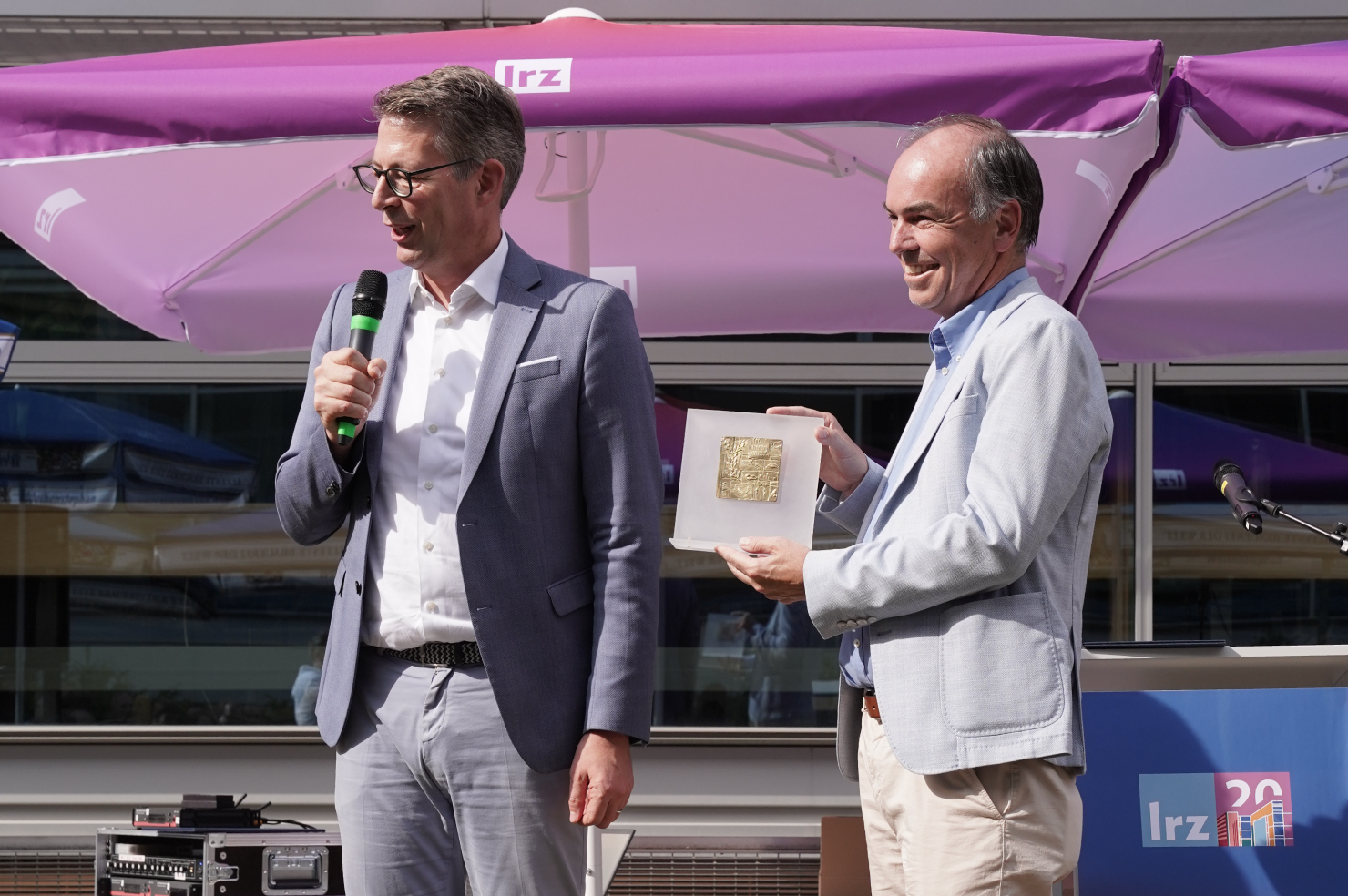

A joyful celebration with an award: Bavaria’s Minister for Science and the Arts, Markus Blume, attended the Leibniz Supercomputing Centre’s (LRZ) summer party at the Garching Forschungscampus on July, 17., 2026 and presented an award to Prof. Dieter Kranzlmüller. In recognition of his contributions to Bavarian science, Blume presented the head of the LRZ with the badge and the art object “Pro Meritis Scientiae et Litterarum”: “Dieter Kranzlmueller makes the future predictable, pushes the boundaries of knowledge and paves the way for others to follow,” said Blume, paying tribute to Kranzlmueller’s commitment to science and research. “As a leading researcher and director of the Leibniz Supercomputing Centre, he combines scientific excellence with a world-class research infrastructure. He creates the conditions that enable Bavaria’s researchers to continually break new scientific ground.”
Kranzlmüller has been a member of the LRZ’s Board of Directors since 2008 and has headed it since 2017. After several years in the IT industry, Kranzlmüller, who holds a PhD in Computer Science, returned to academia and to the Johannes Kepler University in Linz, where he completed his habilitation. Following further research posts at the University of Reading, the École Supérieure de Lyon, Dresden University of Technology and CERN in Geneva, Kranzlmüller accepted a position at Ludwig Maximilian University of Munich, where he took up the Chair of Computer Science and assumed a directorship at the LRZ. Here, the scientist initially drove forward the establishment of the Centre for Virtual Reality and Visualisation (V2C), launched the Future Computing research group and initiated plans for the Quantum Integration Centre (QIC). Today, the LRZ is no longer merely an IT service provider for Bavaria’s universities, nor simply one of Germany’s three supercomputing centres, in the recent years, it has made a name for itself internationally as a pioneer and co-designer of new technologies such as photonic computing
Kranzlmüller was deeply moved to receive the honour from the State Ministry of Science and the Arts, but does not wish it to be seen as a reward solely for his own commitment, but rather as a tribute to the outstanding dedication of “my top-class team”: “Without you, the staff at the LRZ, these successes would not have been possible. It is your ideas, your research and your work that make the LRZ what it is.”