Five years have been particularly formative for this research:
in 1992, the ground shook around the town of Landers in the Mojave Desert—California’s strongest earthquake since 1906, the year of the great San Francisco quake.
In 2004, the most powerful earthquake of modern times struck off the coast of Sumatra, and the ensuing tsunami claimed more than 200,000 lives.
In 2018, earthquakes and a tsunami devastated the city of Palu in Sulawesi, Indonesia.
In 2019, earthquakes of magnitudes 6.4 and 7.1 occurred within two days in Ridgecrest and Searles Valley, California.
In 2023, two particularly strong earthquakes in eastern Turkey took tens of thousands of lives within just nine hours.
Of all natural hazards, earthquakes and tsunamis still claim the most lives. Researchers are therefore working intensively to uncover their causes. The disasters mentioned are repeatedly examined from new perspectives, using new insights and methods. Closely intertwined with this is SeisSol: using the software, which turns 20 this year, earthquakes and their impacts have been modelled many times on the supercomputers of the Leibniz Supercomputing Centre (LRZ).
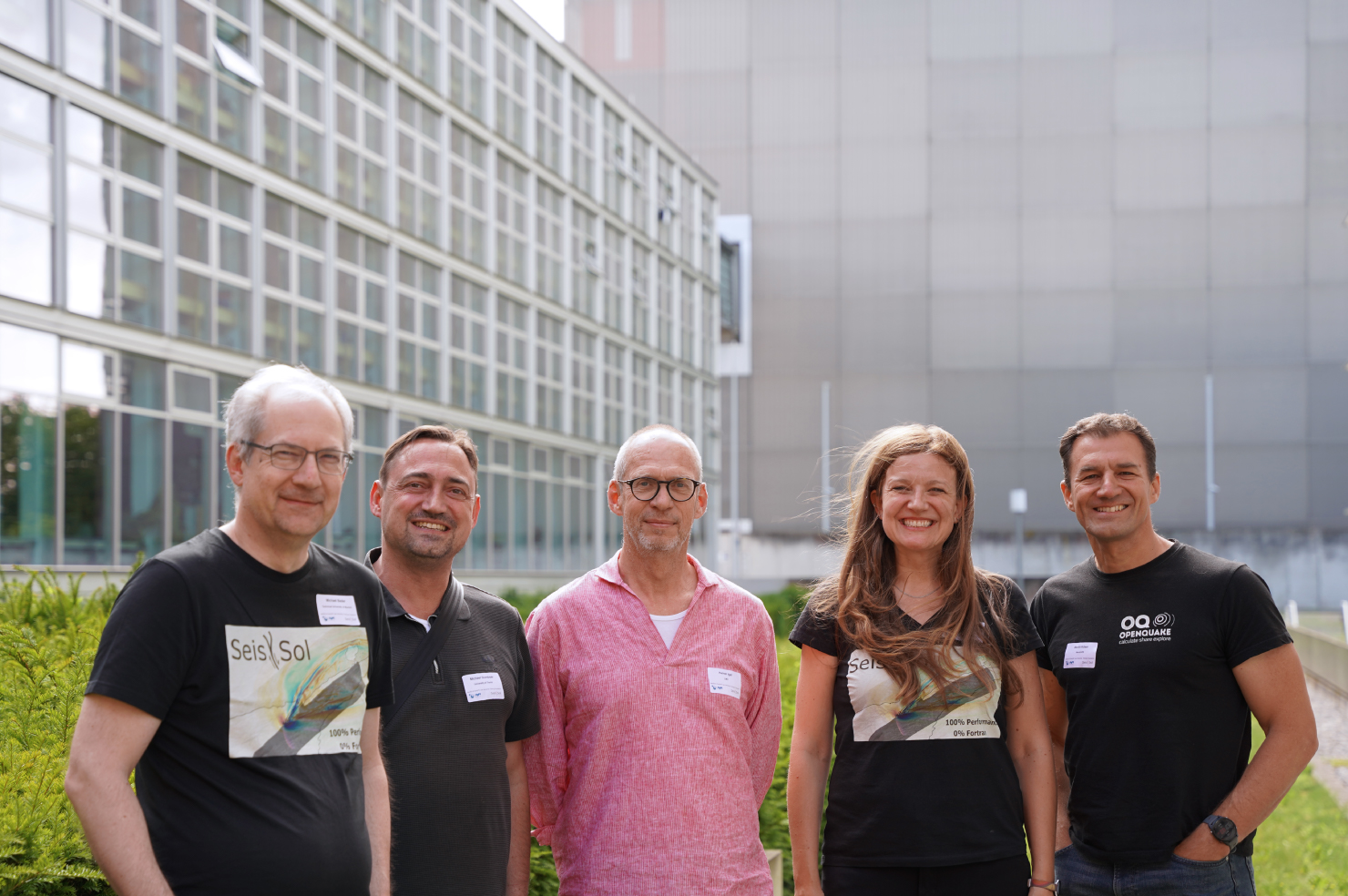
This work has attracted considerable attention and international awards—successes that computer science professor Michael Bader attributes to years of growing, interdisciplinary and trust-based collaboration. Created at the Chair of Geophysics and Seismology at Ludwig-Maximilians-Universität (LMU), SeisSol has been continuously developed in cooperation with the TUM School of Computation, Information and Technology as well as the LRZ:
“It is by no means a given,” observes Bader, “that a research group so readily brings a code it has developed to computer science or to a computing centre for optimisation. Such code often contains the crown jewels of a specific scientific community —fundamental insights embodied in modelling and algorithms. A great deal of trust is required for such collaboration.”
Earthquakes generally occur where tectonic plates are moving beneath the Earth’s surface. If these plates are unable to slide past one another, stress builds up along their boundaries. Layers of rock eventually give way, releasing the stored energy abruptly. In such cases, geophysicists refer to transform earthquakes. Subduction faults are even more destructive: following a collision, one plate is forced beneath another. Anyone investigating the causes of these phenomena examines not only seismic waves but also stress and fracture energy, as well as rock deformation, temperature, subsurface conditions and many other factors. And there are equations for all of these phenomena: “SeisSol uses a discontinuous Galerkin discretisation which, up to 2006, had been applied in computational fluid dynamics but not yet in geophysical applications,” explains geophysicist Alice-Agnes Gabriel, now a professor at the Scripps Institution of Oceanography at the University of San Diego.
She joined the SeisSol team at LMU in 2012 after completing her doctorate, developed a range of simulations, refined fundamental equations, and completed her habilitation in this field in 2022. The code itself, however, originally goes back to mathematician and geophysicist Martin Käser, who, together with numerical analyst Michael Dumbser at LMU, computationally analysed the propagation of seismic waves. Alongside differential equations used to solve questions of wave propagation and earthquake rupture dynamics, they employed the discontinuous Galerkin method (DG) and combined it with a new time-stepping approach, the Arbitrary High-Order DERivatives (ADER) method. The ADER-DG method is based on equations for representing seismic waves: first, these equations are broken down into many small spatial and temporal segments to allow for more precise calculations of wave behaviour; second, the numerous computational steps can be efficiently distributed across thousands of nodes in high-performance computing (HPC) systems. Non-specialists can imagine the difference between DG and ADER-DG results as similar to that between a photograph and a film: while DG calculations produce many individual snapshots, ADER-DG provides smooth transitions. Waves are represented more realistically, making it possible to see what accelerates ground motion.
“In SeisSol, the aim is to simulate the fundamental physics of earthquakes and tsunamis on the basis of sensor data and measurements, and to develop an ever deeper understanding of the processes involved,” Bader summarises. “When I took up my professorship in 2011, the opportunity arose to work on SeisSol. Right from the start, I was drawn to the combination of high-order numerics, high-performance computing and geophysics, which motivated me to engage more closely with SeisSol.”
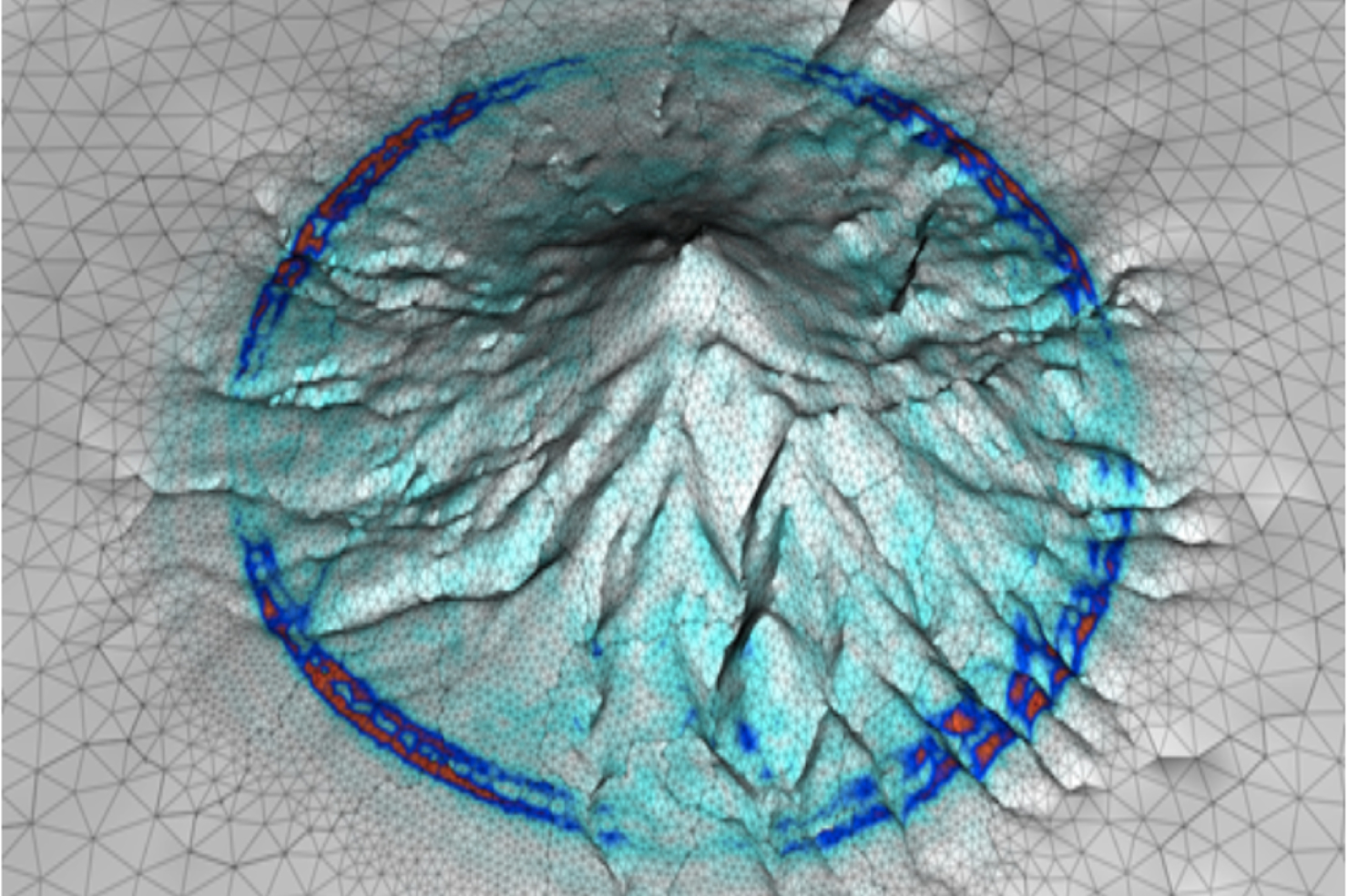
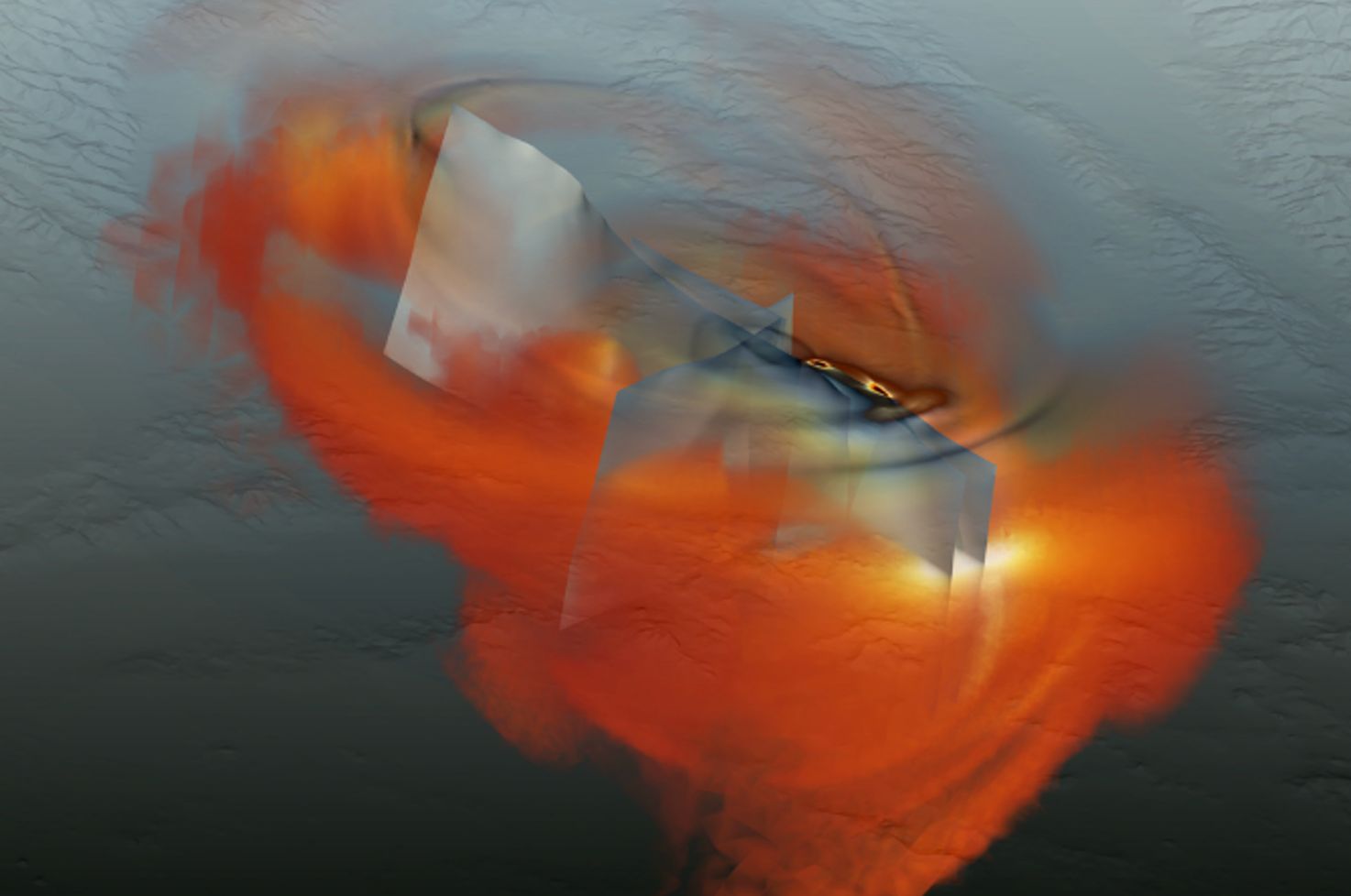
In its early years, SeisSol made a name for itself as a numerical method. With the addition of ever more parameters, it became increasingly complex, even representing wave propagation in three dimensions: “In 2012, SeisSol was the most accurate, but also the most computationally expensive, computer-based method for solving the wave equation,” Gabriel reports. The code delivered precision, but required substantial computing time. This was set to change when the interdisciplinary team from LMU, TUM and LRZ—funded by the German Research Foundation—came together to revise it. At the time, the geophysicists at LMU were considering how to model fault rupture processes and integrate them into SeisSol. The computer science teams at TUM and LRZ also planned to release the code as an open-source programme so that more researchers could use SeisSol: “The previously closed, numerically focused code,” says Gabriel, “became an application-oriented one, with which we were able to model a real earthquake for the first time.”
To achieve this, the geophysics team expanded the set of equations and algorithms to include rupture processes. Meanwhile, computer scientists at TUM, working with specialists at LRZ, optimised the code: algorithms were improved using adaptive time-stepping methods, while performance-critical computations were replaced by new programming approaches. SeisSol’s input and output routines were modernised, and by 2023 the former Fortran code had finally evolved into a C++ package with elements of Python.
The tremors of the Landers earthquake were calculated as the first simulation at petascale level: SeisSol proved highly scalable and efficient, achieving several quadrillion floating-point operations per second (petaflops) on SuperMUC. With this work, the team reached the final of the prestigious Gordon Bell Prize of the Association for Computing Machinery in 2014. Three years later, it won the Best Paper Award at the Supercomputing Conference (SC) in the United States for the longest and most comprehensive simulation to date of the 2004 Sumatra–Andaman earthquake, also computed on SuperMUC.
At the same time, documentation expanded: the team created the website SeisSol.org, linked to source code, tutorials and publications. It provides information licensing and terms of use, and opportunities to explore it in greater depth. SeisSol became firmly established within the international geophysics community with the EU-funded Centre of Excellence for Solid Earth (ChEESE). Between 2019 and 2023, this project produced, among other outcomes, a software package of open-source tools for modelling earthquakes and tsunamis, as well as for improving early-warning systems and assessing risk. In addition to researchers, authorities and companies also use these tools, for instance to evaluate hazards.
“SeisSol is currently evolving into a community code,” says Gabriel. “More and more papers are being published for which SeisSol provides the foundation, and I have never even spoken to many of their authors. SeisSol has come of age.” Nevertheless, Michael Bader still regards SeisSol as a “young code”: “There is a difference between developing a new numerical method and having individual HPC achievements such as performance and scalability recognised. What really matters is usability in science—and here the use of SeisSol is currently growing rapidly.” Recent years have been shaped by technological developments: graphics processing units (GPUs) have become widespread in HPC systems, accelerating and automating traditional simulations, and enabling them to be extended using statistical methods from artificial intelligence (AI). Although SeisSol has long been optimised for heterogeneous systems, Michael Bader sees further challenges ahead: “You are never really finished with a code,” he says with a slight smile. “Once we adapted SeisSol for GPUs, it did not take long before we encountered new challenges everywhere, prompting further improvements.”
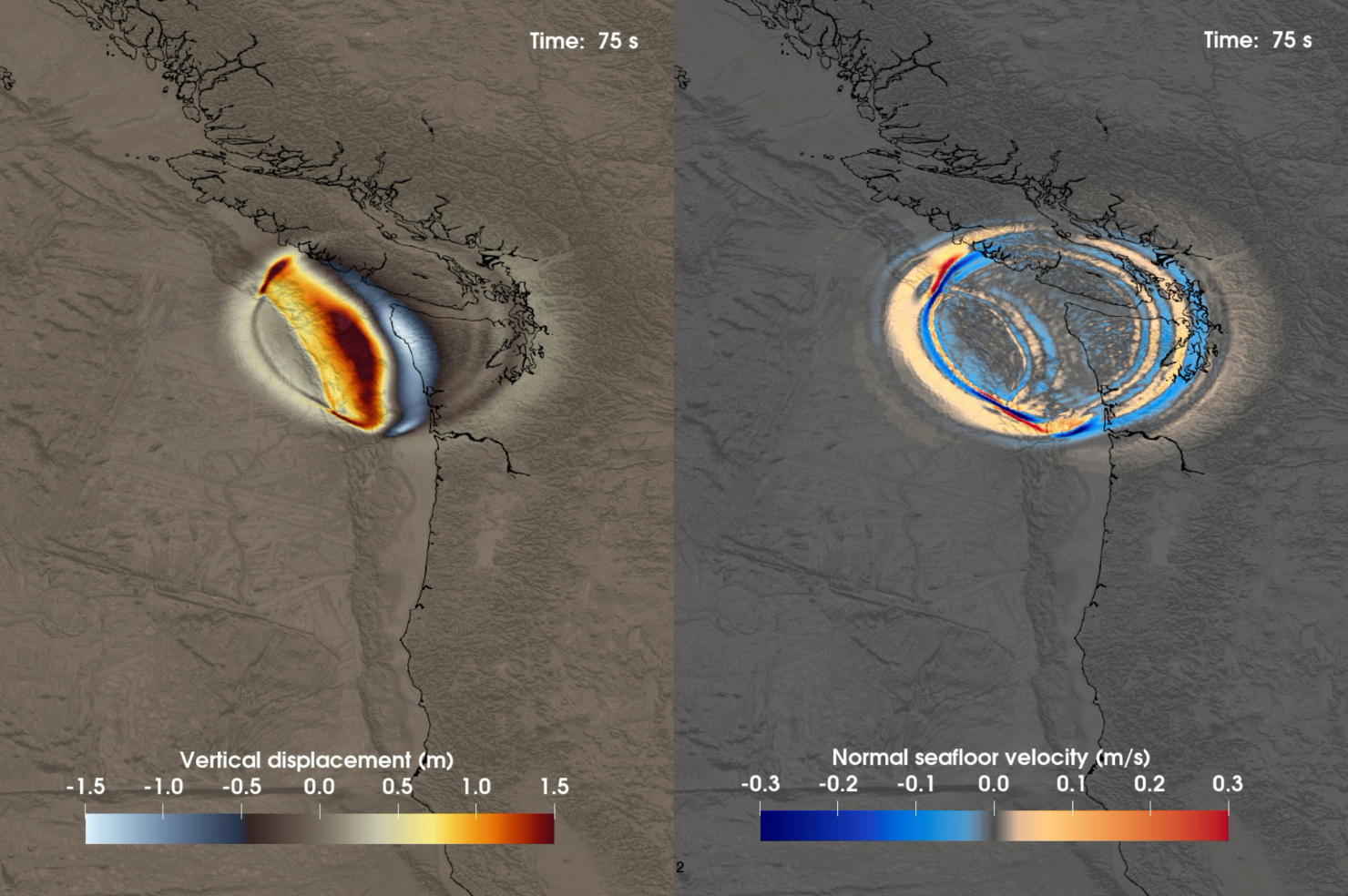
Today, SeisSol is no longer used solely in geophysics; engineers and acousticians also use it to compute flows and wave motion. Geophysics, meanwhile, has shifted its focus towards multi-physics applications: alongside seismic waves, combined tsunami and acoustic wave propagation, as well as complex rupture processes, have come to the fore. Based on SeisSol simulations modelling an earthquake scenario for the Cascadia subduction zone in the north-west of the United States and Canada, a digital twin for tsunami early warning was developed. A team led by the University of Texas won the Gordon Bell Prize in 2025 for this work.
“Following devastating earthquakes and tsunamis, we can now set up SeisSol simulations very quickly—not fully automatically yet, but semi-automated—so we have become part of the rapid scientific response to disasters,” Gabriel explains. “Typically, the tools used directly after earthquakes rely on highly simplified physics. SeisSol now brings supercomputing and very complex calculations into pre- and post-processing, which we have in some sense revolutionised.”
With support from the United States Geological Survey (USGS), the software is now also being used to further improve earthquake early-warning systems. SeisSol additionally helps to produce so-called “shake maps” for particularly at-risk regions by combining real earthquake data with simulation results. Surrogate models, which combine physical modelling with statistical approaches, also help to explain earthquakes and their causes more effectively. And the next advance is already on the horizon: “Quantum computing is an exciting development for many geophysical applications,” says Gabriel. SeisSol will play a role in this as well. “We are not yet able to model details such as the subsurface structure of earthquakes with sufficient accuracy. To achieve this, we need to bring the partial differential equations into quantum computing—initial approaches already exist.” vs | LRZ