Expectations for nuclear fusion are high. Although scientists know that this energy source will not be as cheap to build as solar or wind energy, the energy generated from the controlled fusion of hydrogen isotopes into helium could, in the future, help close gaps in the supply of electricity from renewable sources—likely without the long-term risks associated with nuclear power, such as highly radioactive waste that is difficult to manage and assess.
Researchers and startups worldwide are working on concepts for fusion reactors. They model plasma dynamics under the influence of strong magnetic fields which are used to stabilize particle mixtures under extreme conditions. At the Max Planck Institute for Plasma Physics (IPP) in Garching near Munich, such simulations are an everyday activity. “With GENE-X, we want to simulate plasma turbulence to study the causes of heat and particle losses which help us understand the performance of a fusion device,” said Dr. Philipp Ulbl, a computanional physicist working at IPP. “We also want to target modeling designs of future fusion reactors so that we can predict, among other things, the temperature and density of plasma in steady state reactor operation.”
The GENE code family and especially its latest offspring, GENE-X, has helped with simulations of fusion physics. While many plasma physics codes model particle mixtures found in space, the sun, or stars, GENE was developed specifically for simulating plasmas in reactors, which are based on magnetic confinement. The first GENE code was developed in 1999 at IPP as an open-source application and was gradually optimized for more detailed, three-dimensional simulations as computing power increased. By now, researchers use the code also to simulate the two most common magnetic confinement reactor concepts, the tokamak and the stellarator.
The newest version, GENE‑X, is now being prepared for deployment on supercomputers accelerated by graphics processing units (GPUs). The team is currently working on implementing GENE‑X on the SuperMUC-NG Phase 2 (SNG‑2) at Leibniz Supercomputing Centre (LRZ), which uses Intel chips. “Intel is a comparatively new player in the GPU market, where manufacturers such as NVIDIA and AMD have been dominating the market for a while” says Jordy Trilaksono from IPP, who is responsible for adapting the code. “If we want to make our application widely available, GENE‑X should run as many of the major processor types as possible. We also want to become independent of specific vendors.”
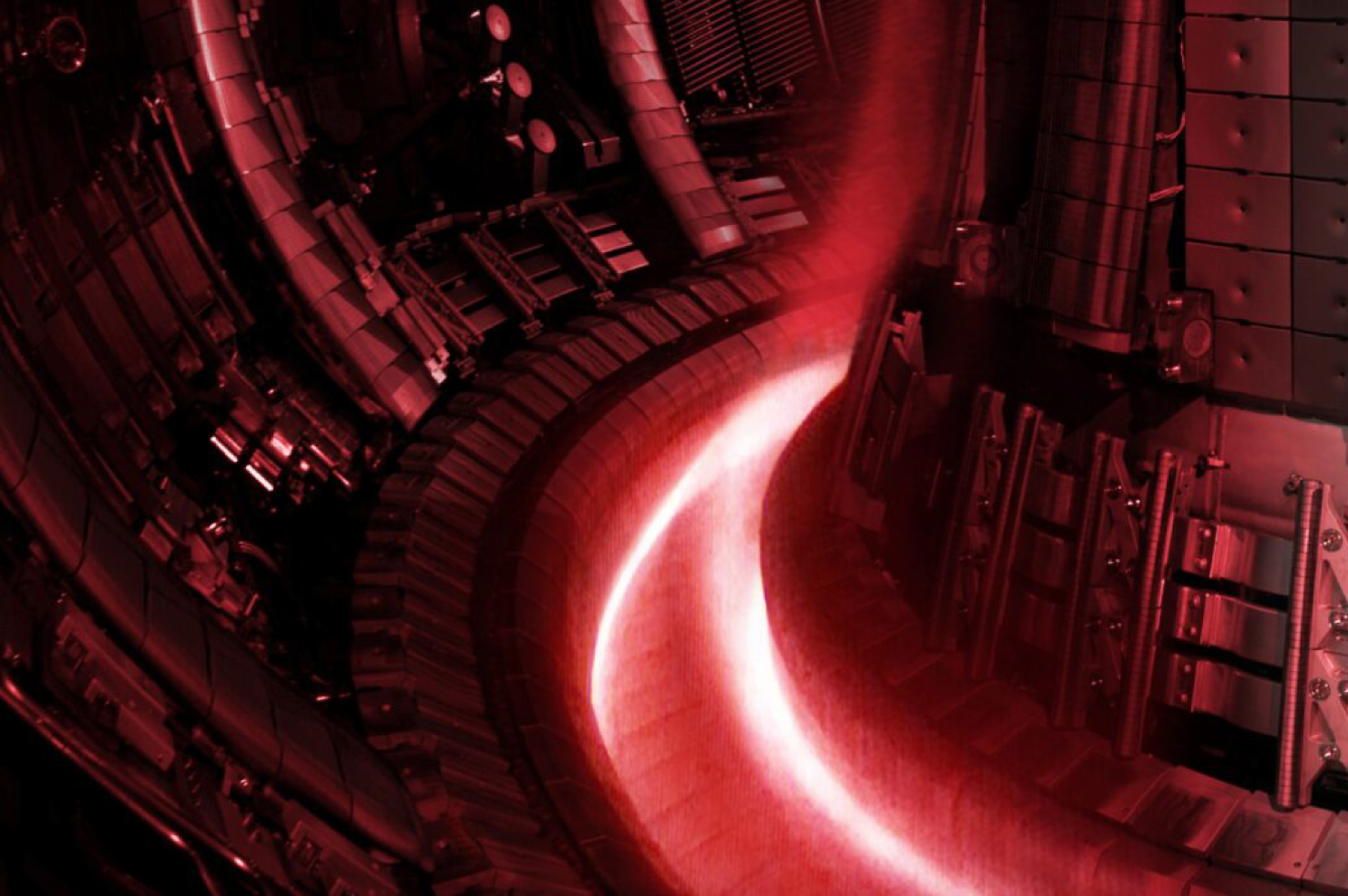
Thanks in part to the GENE codes, computer-supported fusion simulations have become increasingly precise over recent decades, and their results can now be compared with observations from experimental fusion facilities. This iteration helps reduce costs for expensive reactors and experiments. For the modeling activities planned, the IPP team aims to process measurement data from the Joint European Torus (JET), a tokamak. This experimental fusion facility was the largest in Europe to date. It operated until 2023 in Culham, UK, and by the end of its operational life, it was able to generate 69 megajoules or about 20 kilowatt-hours of energy from 0.2 milligrams of plasma – enough to power an electric car for about 100 kilometers. Beyond this record, JET delivered massive amounts of data, most of which remains unanalyzed. "JET contains unique data on hydrogen isotope mixtures, which is particularly valuable for studying plasma turbulence", says Dr. Baptiste Frei, a researcher at IPP, who’s conducting simulations for the project.
Of the more than 100,000 discharges of JET, the IPP team plans to analyze only three, from which GENE-X generates approximately 50 terabytes of data. “If the GENE‑X code runs faster, you can integrate more parameters into the model and process the resulting larger volumes of data much more quickly,” explained Dr. Sajjad Azizi. The astrophysicist is part of the Computational X Support Team at LRZ and advises the IPP group in the transformation and implementation of GENE‑X. “By adapting the code to GPUs, researchers can leverage the full computing power of HPC systems like SNG‑2. Scientific simulations are computationally demanding because they must account for many parameters and complex interactions between computing components. Pure CPU execution can easily become a bottleneck.” And the researchers have big plans: With GENE-X, they aim to model not just parts of the fusion facility, as they have done so far, but the entire plant — from the walls to the core
Given the growing use of artificial intelligence (AI) methods in plasma physics as well, the IPP team is taking a more fundamental approach to reworking GENE‑X. The code, originally written in Fortran, is first being extended with an auxiliary C++ layer. This not only increases the range of programming models and tools with which the code can be adapted for future simulation tasks, but also makes it easier to accelerate simulations with GPUs and to combine it with AI models or AI‑supported tools built in C++ languages. These could complement high-performance computing (HPC) methods. This porting work brings computational research another step closer to creating digital twins of fusion plasma and technologies. “The Fortran/C++ hybrid mode of GENE‑X can run on CPUs using OpenMP or on GPUs using OpenACC or OpenMP offload,” Trilaksono added, highlighting further advantages of the code transformation. As a result, GENE‑X gains flexibility, making it easier to adapt to different hardware and operating systems.
Occasionally AI also helps with modifying the code. “It still makes mistakes, of course, but it is often faster at finding errors,” said LRZ specialist Azizi. He recounted a build issue where code lines were repeatedly rewritten with debugging messages and tested on the SNG‑2 to narrow down the cause step by step. The team worked on this for some time, but AI found the simple solution very quickly: an outdated programming tool the specialists had started out with.
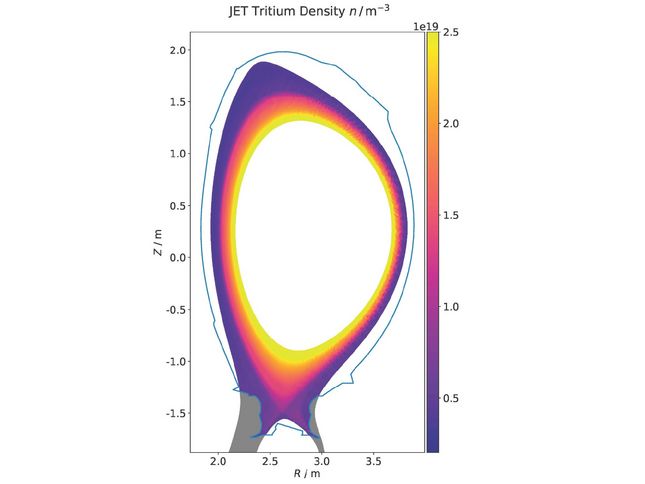
The graphic shows the plasma density. The blue line marks the reactor wall, and the grey areas represent divertor plates that dissipate heat. The goal of the researchers: Using GENE‑X to compute the complete fusion process — from the core, which cannot yet be fully modeled, all the way to the reactor wall.
All researchers involved agree that the computational paradigm shifts make this porting work more complicated. “Previously, the code transition to a new computing generation took days or weeks. The switch to GPUs is much more demanding,” Ulbl said. “We already have a CUDA version of GENE‑X that we can certainly rewrite into SYCL, but that will take time.” The first version of GENE‑X was adapted on supercomputers at the Max Planck Institute as well as on the Spanish supercomputer Mare Nostrum 5 in Barcelona. Early versions confirm researchers’ expectations that GENE‑X would show substantial performance gains. The researchers saw an increase of up to a factor of 10, meaning it runs ten times faster than its predecessor on only CPU systems.
The new code is currently being adapted to Intel GPUs. For this purpose, the LRZ support team regularly implements and tests parts of the program on SuperMUC-NG and its companion system SNG‑2. Operating metrics from these test runs, along with comparison figures from similar applications, provide clues about where algorithms can be modified and functions optimized. By autumn this year, the team hopes to run the first GENE-X-simulations on Intel GPUs. The resulting data is intended to help train AI models in the medium term and accelerate the optimization of fusion concepts.
“With GENE‑X, we want to enable the simulation of power plants that achieve at least a performance factor of 10 times larger than JET,” said Ulbl. He noted growing interest in the fusion code. In many countries, politics are promoting fusion research and the development of new technologies, and the first startups and companies are entering the field. “This is another reason why we want to adapt and improve GENE‑X,” Ulbl explained, “to support people and companies working on nuclear fusion and building the first commercial reactors.” (vs | Eric Gedenk | LRZ)