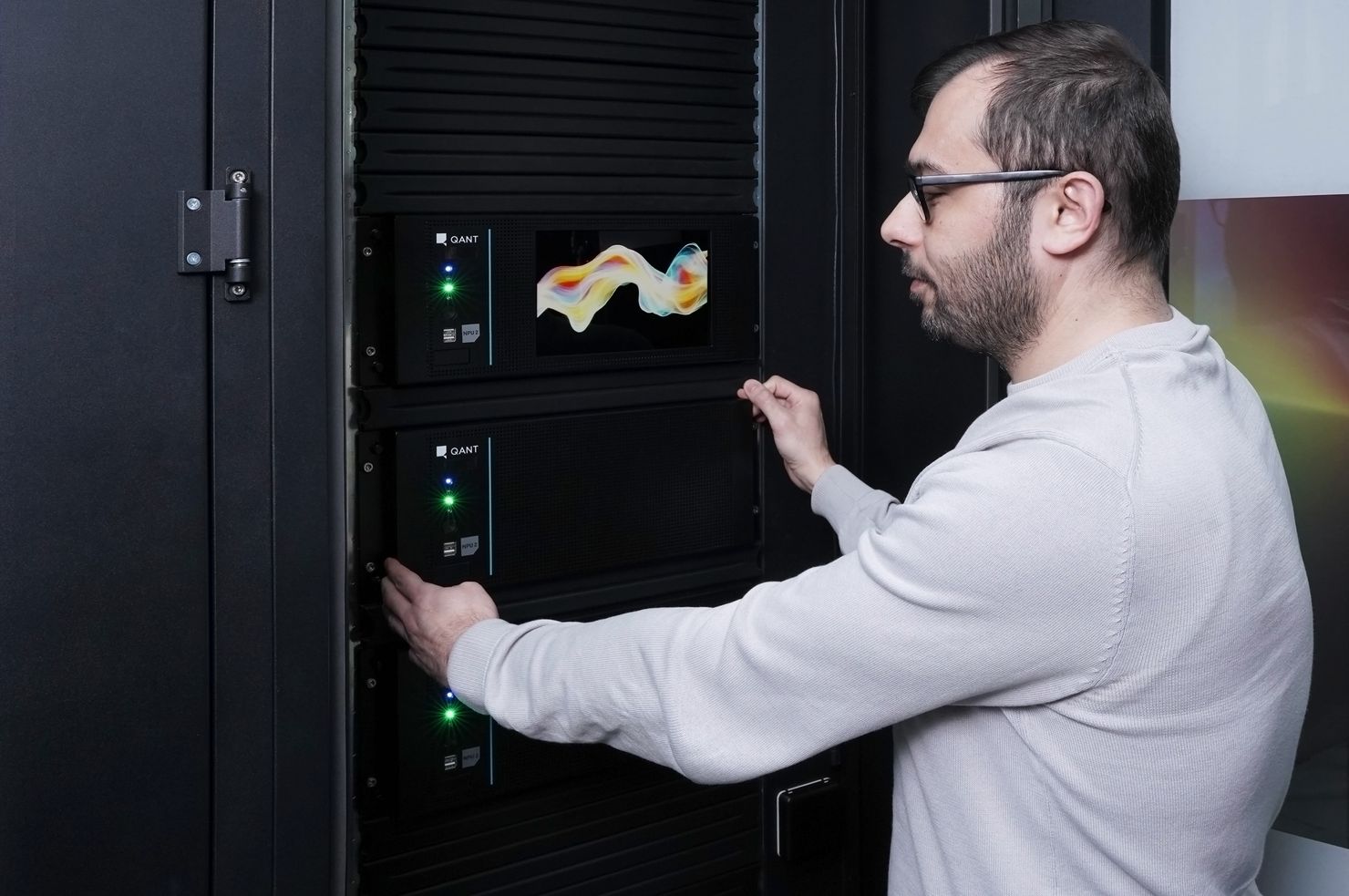
Q.ANT announced the deployment of its second-generation photonic processors in a high-performance computing (HPC) environment at the Leibniz Supercomputing Centre (LRZ). This deployment marks an important step toward integrating light-based co-processing into production data center operations to reduce the escalating energy and performance constraints of AI workloads.
Building on its first-generation system at LRZ, Q.ANT’s Gen 2 Native Processing Units (NPUs) act as photonic AI accelerators, delivering higher computational throughput and improved energy efficiency.
In benchmark evaluations at LRZ, Q.ANT’s Gen 2 architecture demonstrated significant improvements over its first-generation NPUs, marking the next milestone in the company’s product development roadmap. Results include:
Unlike electronic processors that rely on transistor switching, Q.ANT’s photonic NPUs execute mathematical operations directly in the optical domain using Thin-Film Lithium Niobate (TFLN) photonic integrated circuits, eliminating on-chip heat generation and cooling requirements.
“This deployment highlights the technological progress from the first to the second generation of Q.ANT’s processors,” said Prof. Dr. Dieter Kranzlmüller, Chairman of the Board of Directors of LRZ. “Our evaluation is conducted under real production workloads and operational requirements. Photonic co-processing represents a promising approach to addressing the performance and energy challenges increasingly defining modern high-performance computing.”
“Adding more digital hardware no longer solves the compute scaling problem in AI,” said Dr. Michael Förtsch, CEO of Q.ANT. “If we continue to scale with brute-force transistor logic, we simply turn electricity into heat. At LRZ, we’re proving that light-based co-processing can integrate with today’s infrastructure and deliver measurable efficiency gains under real workloads. This is how AI can continue to scale without scaling its energy footprint.”
The LRZ installation helps address industrial challenges in compute-intensive applications such as drug discovery, materials design, and adaptive optimization, where nonlinear complexity and energy efficiency are critical. The collaboration was supported by funding from the Federal Ministry of Research, Technology and Space.
You can find the full press release from our technology partner Q.ANT at: https://qant.com/press-releases/higher-performance-less-energy-q-ant-deploys-second-generation-photonic-processors-at-supercomputing-center-lrz/